
Saturday, 31 May 2025
WELCOME TO WINTER!
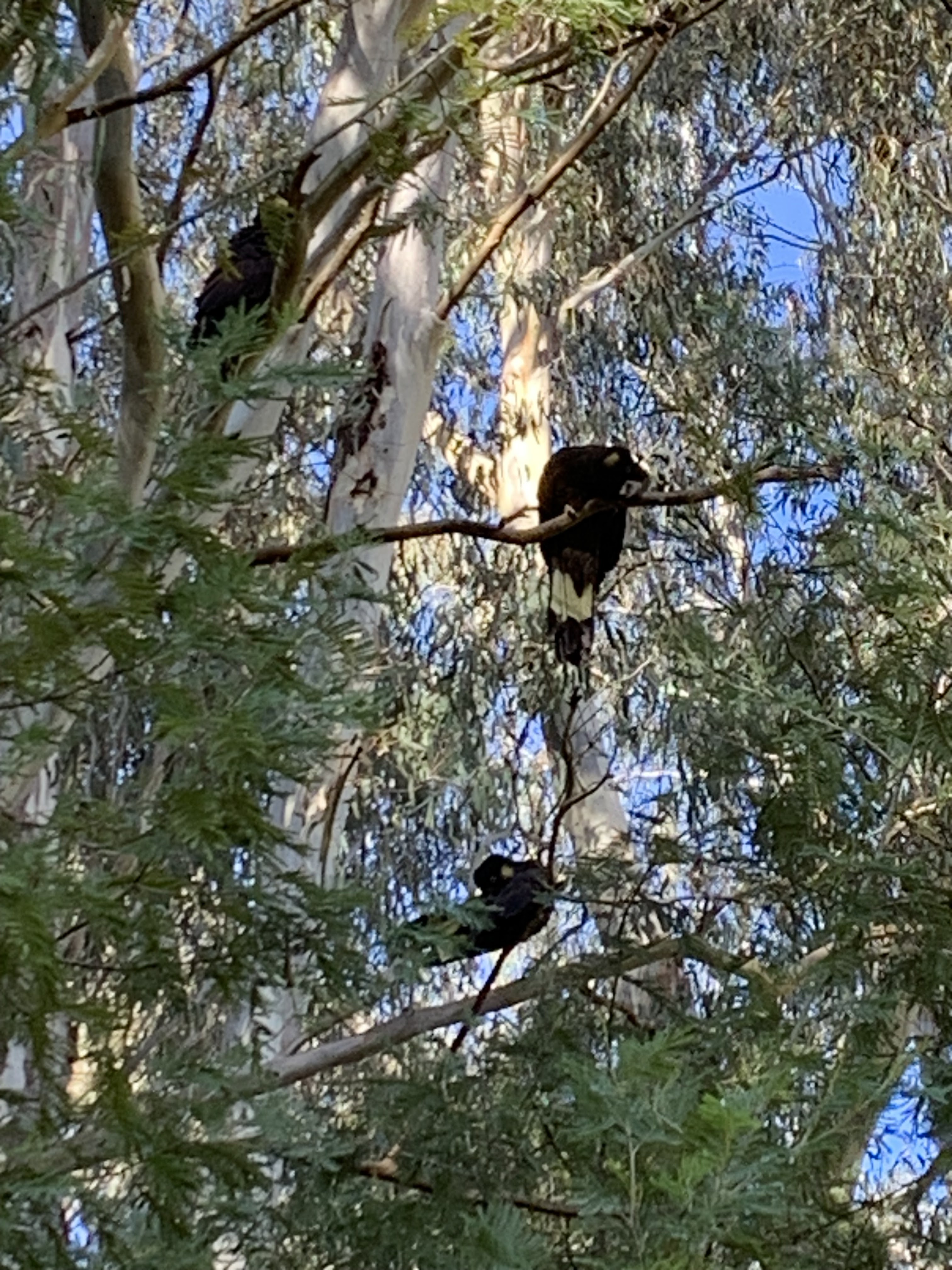
It is a beautiful sunny day today. Not at all wintery. It is no secret that I like the first day of the month. I'm like a school kid with a new exercise book: everything must be perfect on the first page. I start my new monthly birdlist full of optimism. This will be my best June ever. In fact, my best June ever was in 2008, when I saw 259 species! Not bad. However, in June 2008, not only did I spend a weekend at sea (out of Ulladulla), but I visited Iron Range. Any visit to Queensland is going to increase your total significantly. This month, my only trip will be a week in WA, visiting Dirk Hartog Island. I'll have a guide (always an easy way to boost your total) but still it is only a week. If I get 150 for the month, I'll be doing well. Never mind, it is the first day of the month and I'm going to do my best. I started the day as usual with my morning walk. This morning I visited Hay's Paddock. I came home with a grand total of 16, the best bird being an Australian King Parrot. After watching 'Insiders' on TV (compulsory viewing for me) I set off for Willsmere Billabong, an easy walk from home. I thought I might add another 5 species to my monthly total. When I arrived, there was a soccer match in progress on the oval. Welcome Swallows were swooping amongst the players. Magpie-larks, Noisy Miners and Rainbow Lorikeets made their presence felt. I walked straight to the river. There is a path beside the river which can be quite productive. Today I saw Brown Thornbills and White-browed Scrubwren and heard Spotted Pardalotes. I am always pleased to hear pardalotes. Like all our small birds, they are becoming less common. These ones were on the other side of the river, high in the canopy, and there was no chance of seeing them. My disappointment was short-lived because I could suddenly hear black cockies! What a joy! I hurried along the track to where they were playing in a wattle. Seeing black cockies makes me feel good for hours. Some birds do that; just a glimpse gives me a warm glow. These birds put a smile on my face and I quite forgot about not being able to see the pardalotes. Black cockies really are beautiful, big birds. Here's proof. (Sorry, this is the best I could do with my phone.)
 The reason I'd chosen Willsmere as my first walk for the month, was that I was hoping that my friendly frogmouths would be sitting at home in their gum tree as they should be. They went AWOL for several months, but they were back in May and I had every reason to hope that they'd still be there to celebrate the first day of June with me. A pair of Tawny Frogmouths lives in Stradbroke Park, quite close to home, but they went AWOL last December and have not yet returned home. My Willsmere birds had moved a few trees away, but were still visible until they returned to their rightful tree last month. As soon as I could drag myself away from the Yellow-tailed Black Cockatoos I hurried to 'the' tree, and instantly saw just one frogmouth. He was pretending to sleep, but I could see that he was in fact well aware of my presence through his seemingly shut eyes. He was quite high in the tree, safely above photographic height for my phone. I was satisfied just to admire him. I sat on the seat by the river and wrote up the birds I'd seen. I was quite pleased with myself, despite knowing that, had I done the same walk thirty years ago, I would have seen at least twice as many birds. There would have been honeyeaters and whistlers and perhaps even an Azure Kingfisher. I put this unwanted thought out of my head and set off for the billabong. There were black ducks, one Australasian Grebe and one Little Black Cormorant. Without adding Red-rumped Parrots, Eastern Rosellas or Common Bronzewings to my list (all birds I'd expected to see) I continued my walk. As elsewhere around Melbourne, things were pretty dry. The creek (really a drain) that empties into the billabong wasn't running, so I didn't bother checking for herons. Nor did I examine the golf course for Maned Duck. I still hoped to get fairywrens onto the list, and turned for home. There were too many Noisy Miners (let's face it, one is too many) and quite a few welcome Brown Thornbills, but alas no fairywrens. I'll have to make do with black White-winged Fairywrens on Dirk Hartog. (White-winged Fairywrens everywhere else in Australia are an attractive deep blue and I've always hankered after a black one. Hence the trip to Dirk Hartog.) Still glowing from my black cockies, I went home happy. I'd added 8 birds to my monthly total. I'd seen my frogmouth AND I'd seen black cockies.

Sunday, 20 April 2025
MY SECOND SOUTHPORT PELAGIC FOR 2025
AND MY FOURTH UNSUCCESSFUL ATTEMPT TO SEE A NEW CALEDONIAN STORM PETREL!
With my birding mate, Helen Yuille, I left early on Good Friday morning to fly to the Gold Coast. Helen had never done a pelagic and I had suggested that the Southport pelagic would be a nice easy one to start with. So we flew up early to get in a day's birding before our big adventure on Saturday. Of course, all I cared about was the chance to see my New Caledonian bird. I had been told that April was the most likely month. However, it seems to me that no month is very likely, and there is a very small chance in every summer month. Helen and I picked up a hire car and drove to Sandy Camp Road. My friend, Rae Clark, had taken me to this spot in January, when I'd made an earlier (failed) attempt to see a this special exciting but elusive storm petrel.
 Sandy Camp Road is a lovely spot. We saw several Australasian Darters, lots of Brown Honeyeaters and a few Lewin's. I saw just one Mistletoebird. The highlight was, without doubt, the Little Heron which Helen spied. Until recently we called this bird a 'Striated Heron,' which, to me seems a much better name. Two very noisy and intimidating motor bikes ruined our peaceful wander, so we left and drove on to Wynnum Mangrove Boardwalk, where we were greeted in the carpark by an Australasian Figbird. This, too, is a great birding spot, also introduced to me by Rae Clark. Thank you Rae!
 For me, the best bird here was a Torresian Kingfisher. For Helen, it was the very prolific Mangrove Gerygones, a lifer for her. For a friendly birding local, it was Black Swans, which I gather are not common at this site. I added Spangled Drongo and Noisy Friarbird to my list. About this time, we realized that we hadn't had any lunch, and that breakfast had been a long time ago.
 We were staying in Southport, and decided to check out which jetty the boat was scheduled to leave from at 5.30 tomorrow morning, giving me a chance to admire the friendly local Brushturkeys and Bush Stone-curlews. Then we booked into our accommodation, with only a minor altercation about whether or not I had pre-paid for my room. With that matter resolved, we set off to sort out tomorrow's breakfast. On previous trips to Southport, I'd bought something at the handy Safeway, so Helen and I set off with this in mind. Unfortunately, I hadn't allowed for shop closures on Good Friday! A very helpful woman in a local bar directed us to the IGA and the problem was solved. We were up bright and early on Saturday and managed to find the right jetty and the right boat. Cyclone Alfred has moved a lot of sand from Gold Coast beaches, and also apparently changed the water depth at the bar. Having told Helen this was an easy, flat pelagic, I was unhappy to hear our captain, Grinner, instructing us all to 'hang on!' He clearly meant it, and I hadn't heard him say this before. When we crossed the bar, we understood why. The boat was tossed around like a matchbox. Grinner told me that boats had been unable to cross the bar the day before. In my (admittedly limited) experience, Southport pelagics are the most comfortable, but they also provide the fewest birds. I had virtually promised Helen a Tahiti Petrel - a bird I thought was guaranteed on a Southport pelagic. Initially we saw Silver Gulls and Greater Crested Terns and not much else. After a while, there was a sprinkling of shearwaters (all Wedge-tailed I think). The Tahiti Petrel kept us waiting a long time, but we did eventually see one or two. Also Kermadec and Providence Petrels. The only storm petrels, I'm sorry to say, were Wilson's and White-faced. Not a hint of anything as exotic as a New Caledonian. The undoubted highlight of the trip was a Bulwer's Petrel. This photo was taken by Patrick Reed.
 On the way back to port, we saw some Hutton's Shearwaters, and when we were almost home, we saw our first Australasian Gannet for the day, bringing the day's total species count to 13. I must say I enjoyed the day. Naturally, I would have enjoyed it more had I seen a New Caledonian Storm Petrel. However, now I have my excuse to return and I have booked a spot on the boat for next March.


Thursday, 20 March 2025
WERRIBEE ONCE MORE


Thursday, 27 February 2025
FEBRUARY
Birding in Melbourne in February is often a difficult month for me. I always start the year with a burst of enthusiasm, and when February comes around, I've seen just about everything Melbourne has on easy offer. I have to work very hard in February to see anything new. Or travel interstate. This February, I've had a particularly good month. I've seen 195 birds, which is pretty good for any month. I've had a (very expensive) trip to Tassie for a pelagic out of Eaglehawk Neck (always fun), a lovely day at Werribee's Western Treatment Plant, and a few days in Mallacoota, surely a birder's heaven. Now I'm having trouble deciding on the bird of the month. What an excellent problem to have!
 This photo by Els Wakefield is a Salvin's Albatross, a bird I don't often see, and clearly the Bird of the Day for my Tasmanian pelagic. (My trip to Tassie was expensive because the weekend I'd chosen was, unbeknown to me, the weekend of three festivals, and all Hobart hotels put their prices up accordingly. I don't think I've ever paid $685 for one night's accommodation before. But perhaps I'm just out of touch.) I did enjoy the pelagic. It is a very friendly boat and it was a very pleasant day at sea. The Salvin's Albatross landed right beside me, giving me an excellent view. It really had no contest for Bird of the Day.
 I had a lovely day at Werribee. As one of my NSW birding friends once quipped, "It's impossible to have a bad day at Werribee." I had hoped to see 100 birds that day at Werribee (something I have never achieved) but only managed 92. It was hot. We could have driven around some more, but common sense prevailed, and when all's said and done, 92 is not a bad day's count. I did not manage any of the rarities recently reported, apart from Pectoral Sandpipers (if I'm allowed to call them 'rare,' I suspect that 'uncommon' is a better adjective), but there were three birds, wandering around quite close to the car, not at all worried by our presence. They were fun. But my Bird of the Day was, perhaps perversely, the much more common Blue-winged Parrot. This lovely photo was not taken on the day. It is by Ken Haines. There were three Blue-winged Parrots (not everything was in threes that day!) which flew low overhead, then later, another three (or perhaps the same birds) landed right beside us on the fence, allowing us to absorb their beauty. So many of our parrots are truly gorgeous specimens.
And another worthy contender for Bird of the Month.
I had a lovely day at Werribee. As one of my NSW birding friends once quipped, "It's impossible to have a bad day at Werribee." I had hoped to see 100 birds that day at Werribee (something I have never achieved) but only managed 92. It was hot. We could have driven around some more, but common sense prevailed, and when all's said and done, 92 is not a bad day's count. I did not manage any of the rarities recently reported, apart from Pectoral Sandpipers (if I'm allowed to call them 'rare,' I suspect that 'uncommon' is a better adjective), but there were three birds, wandering around quite close to the car, not at all worried by our presence. They were fun. But my Bird of the Day was, perhaps perversely, the much more common Blue-winged Parrot. This lovely photo was not taken on the day. It is by Ken Haines. There were three Blue-winged Parrots (not everything was in threes that day!) which flew low overhead, then later, another three (or perhaps the same birds) landed right beside us on the fence, allowing us to absorb their beauty. So many of our parrots are truly gorgeous specimens.
And another worthy contender for Bird of the Month.
 I had good birds in Tasmania, at Werribee and at Mallacoota, but one bird which gave me as much pleasure as anything else, was an Eastern Spinebill in my front yard! (This beautiful photo is again by Ken Haines.) When I purchased my present house in Kew, about the first thing I did was to plant grevilleas in the front yard, in the hope of attracting Eastern Spinebills. Not many years ago, I often saw Eastern Spinebills in Kew. Now I never do. My planting has only attracted Red Wattlebirds. But one day this month, I had an Eastern Spinebill in my front yard. I love these birds (who doesn't?) A clear contender for Bird of the Month. It certainly gave me a great deal of pleasure. Unfortunately, it did not hang around and I have not seen it again since.
 As always, I had quite a long wishlist for my recent trip to Mallacoota. This included any nightbird (the only one on my 2025 list was a Tawny Frogmouth), the Tawny Grassbird (which had recently been reported from Orbost, a bird I'd never seen in Victoria), Scarlet Myzomela (a bird, which although it is not rare, I do not often see) and Glossy Black Cockatoos, which I really wanted to see as I've only seen them once since the dreadful bushfires of 2019/20. This photo was taken on that occasion by Graham Barwell in Cranbourne Botanic Gardens. Last year when I visited Mallacoota, I did not see any Glossy Black Cockatoos, and I can assure you that it was not for want of trying. This year, I saw six. They were on Tower Road, Mt Raymond. And very beautiful they were too. Certainly worthy to be Bird of the Month. However, I have decided on something else as my Bird of the Month for February. I have decided on the Topknot Pigeon, which I saw at Cabbage Tree on my way to Mallacoota. It was my first Victorian sighting of this odd-looking pigeon. I wonder what I'll see in March.


Saturday, 22 February 2025
MARVELLOUS MALLACOOTA


Tuesday, 31 December 2024
ALL THIS AND A KOEL TOO!
What a lovely start I've had to 2025! My morning walk on the first of the month is always to Hay's Paddock. This is just a short walk and I usually see around 17-18 species of birds. The worst I did last year on this walk was 11 species in both February and May. The best I did was 23 in July, then 22 (just twice) in April and September. It is, as I say, usually more like 17 or 18. This morning I recorded 23 species: 20 I saw, and a further 3 I heard. Best were an Australian Reed Warbler and a Nankeen Night Heron. Night herons used to be seen around here more frequently than they are today. I believe I've seen them just 3 or 4 times on this walk in the last (almost) four years. I thought that was an auspicious start to the year, as I set off for my usual first of January birding spot: Banyule. Apart from the ridiculously large number of rabbits and the obscenely overgrown grass I had to wade through, it was a pretty good couple of hours. I was greeted by a mixed flock of ibis on the oval.
 Australian White Ibis are reasonably common in Kew, but Straw-necked are not. I walked around to the grotty pond. Unfortunately, it is sadly overgrown. It would be extremely difficult to see any crakes or snipe that happened to be there. Nevertheless, I opened the gate as quietly as possible, and veered to the left to avoid a rabbit. I'd rather all rabbits were eradicated, but I didn't wish this particular animal any harm, and I'd rather not create alarm among wild creatures. So I approached the pond from the far left. I confirmed that I would be unable to see any bird present and was turning to leave, when a Latham's Snipe flushed from the edge of the vegetation. I noted that it did not zigzag in flight (a habit I thought they all possessed) and took a step towards where it had come from. Another bird flushed immediately. So while the grotty pond is tantamount to invisible, it's probably still worth a visit, to see if there's anything hanging around nearby. I was serenaded by several Common Bronzewings as I exited as quietly as possible. There was not a great deal on the lake. (I've heard people refer to this body of water as a 'billabong,' but it seems to me to be too far from the river to deserve this name.) There were Pink-eared Ducks, Australasian Grebes and all the usual suspects. I had 22 species on my list as I walked down to inspect the water more closely. I was delighted to see a pair of Masked Lapwings land near the water. If I hadn't seen them land, I would not have known they were there. These birds used to be common at Banyule, indeed I used to see them often in Kew, but nowadays I see them locally less and less frequently. At the water, I saw another Nankeen Night Heron and thought that on any other day, that would be a good sighting. Today, I'd already seen one at Hay's Paddock. I added Red-rumped Parrots and Dusky Moorhens to my list and set off for the river. The sun was not out; there were few insects and few passerines. I heard a Grey Fantail and saw several Brown Thornbills, but I was a little disappointed in the small number of small birds. I saw a fox and a Black-faced Cuckooshrike, but there were no Bell Miners. Until recently, this had been a reliable spot for them. I was quite pleased that they'd moved on to give the trees a chance to recover from their presence. I was sorry that I had not heard any orioles. In fact, I don't believe that I've heard one this summer at all. I looked in all the usual spots for frogmouths and owls, but had no luck. I saw a Long-billed Corella, not nearly as common here as our usual Little Corellas. And I saw a Kookaburra. Here's proof:
 Then a Pacific Koel demanded my attention. He called constantly and he wasn't far away. I tracked him down. It wasn't too hard. He was sitting high in a gumtree, announcing his presence to the world. I wished him a Happy New Year, and returned home, quite satisfied with my first day's birding for 2025.


Monday, 30 December 2024
BIRD OF THE MONTH 2024
My awards for the Bird of the Month 2024 are as follows:
JANUARY: TAWNY FROGMOUTH:
I've always loved Tawny Frogmouths and I try to get them onto my birdlist every month. I have a couple of local spots I check every month, but if these birds let me down, I go to Blackburn, where I'm usually successful, or Royal Park. This photo was taken in Royal Park by Peter Petinatus.
 FEBRUARY: RED KNOT:
The Red Knot is not a rare bird, but it is one I don't often see. In February I saw them at Werribee, hence it became the Bird of the Month. This beautiful photo is by David Hollands. I took it from 'Waders, The Shorebirds of Australia' by David Hollands and Clive Minton. The Red Knots really stand out. The ones I saw at Werribee were not in breeding plumage, and did not stand out. They melted into the background of other anonymous waders. The photo also shows Grey-tailed Tattlers, Sand Plovers and Curlew Sandpipers.
FEBRUARY: RED KNOT:
The Red Knot is not a rare bird, but it is one I don't often see. In February I saw them at Werribee, hence it became the Bird of the Month. This beautiful photo is by David Hollands. I took it from 'Waders, The Shorebirds of Australia' by David Hollands and Clive Minton. The Red Knots really stand out. The ones I saw at Werribee were not in breeding plumage, and did not stand out. They melted into the background of other anonymous waders. The photo also shows Grey-tailed Tattlers, Sand Plovers and Curlew Sandpipers.
 MARCH: MANGROVE GERYGONE:
I saw this bird at Wynnum Mangrove Boardwalk in Brisbane, where Rae Clark took me birding. (Thank you, Rae!) Although it is not rare, it is a bird I do not see every year and it is a dear little thing, I'm sure you'll agree. I sometimes think it has been mis-named: I don't see them in Mangroves. I see them in paperbarks, adjacent to Mangroves. This photo is Peter Marsack's illustration in the Australian Bird Guide.
MARCH: MANGROVE GERYGONE:
I saw this bird at Wynnum Mangrove Boardwalk in Brisbane, where Rae Clark took me birding. (Thank you, Rae!) Although it is not rare, it is a bird I do not see every year and it is a dear little thing, I'm sure you'll agree. I sometimes think it has been mis-named: I don't see them in Mangroves. I see them in paperbarks, adjacent to Mangroves. This photo is Peter Marsack's illustration in the Australian Bird Guide.
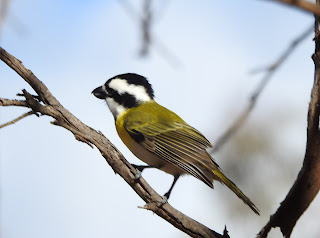
 APRIL: WESTERN SHRIKETIT:
My first lifer for the year. I put in some effort for this bird, then, when I saw it, it couldn't have been easier. It was at the traditional spot, by the water feature at the Stirling Range Retreat, right on cue. I had looked for it on a previous visit to Western Australia, and failed, so this was a special trip to the other side of the continent. And well worth it too. I don't think the Western Shriketit is as pretty as our Eastern one, but a tick's a tick in anyone's language. Des Hume showed me this bird and took this photo. Thank you, Des.
APRIL: WESTERN SHRIKETIT:
My first lifer for the year. I put in some effort for this bird, then, when I saw it, it couldn't have been easier. It was at the traditional spot, by the water feature at the Stirling Range Retreat, right on cue. I had looked for it on a previous visit to Western Australia, and failed, so this was a special trip to the other side of the continent. And well worth it too. I don't think the Western Shriketit is as pretty as our Eastern one, but a tick's a tick in anyone's language. Des Hume showed me this bird and took this photo. Thank you, Des.
 MAY: HOODED ROBIN:
Hooded Robins bred every year on my parents' property in north-central Victoria. I was with my parents the day they decided to buy the property, and I reckon it was a Hooded Robin that clinched the deal! I love all those birds of the box/ironbark countryside. Hooded Robins in particular always remind me of my parents' place. In May, I saw them in the Warby Ranges, on my way to check out the birds of Chiltern. Again, I took this illustraion from the Australian Bird Guide. It is another of Peter Marsack's lovely images.
MAY: HOODED ROBIN:
Hooded Robins bred every year on my parents' property in north-central Victoria. I was with my parents the day they decided to buy the property, and I reckon it was a Hooded Robin that clinched the deal! I love all those birds of the box/ironbark countryside. Hooded Robins in particular always remind me of my parents' place. In May, I saw them in the Warby Ranges, on my way to check out the birds of Chiltern. Again, I took this illustraion from the Australian Bird Guide. It is another of Peter Marsack's lovely images.
 JUNE: SANDHILL GRASSWREN:
I saw this bird in June, but it was not split by the IOC until July. Louis Masarei showed it to me at Sandstone in WA. I have been unable to find an illustration of it.
JULY: SUPERB LYREBIRD:
My birdy friend, Helen Yuille, wanted to see a lyrebird. With great confidence, I said I'd show her one. Of course I'd seen them countless times. And I reckon I could find one easily enough in far east Gippsland. But where could I guarantee to find one a short drive from of Melbourne? I thought perhaps Healesville, but (after consulting some people who know a lot more than me) decided on Sherbrooke. Helen and I found the recommended track and heard lyrebirds almost immediately. Then we saw them: I think we saw three altogether, but one bird in particular put on an impressive display. Mission accomplished!
JUNE: SANDHILL GRASSWREN:
I saw this bird in June, but it was not split by the IOC until July. Louis Masarei showed it to me at Sandstone in WA. I have been unable to find an illustration of it.
JULY: SUPERB LYREBIRD:
My birdy friend, Helen Yuille, wanted to see a lyrebird. With great confidence, I said I'd show her one. Of course I'd seen them countless times. And I reckon I could find one easily enough in far east Gippsland. But where could I guarantee to find one a short drive from of Melbourne? I thought perhaps Healesville, but (after consulting some people who know a lot more than me) decided on Sherbrooke. Helen and I found the recommended track and heard lyrebirds almost immediately. Then we saw them: I think we saw three altogether, but one bird in particular put on an impressive display. Mission accomplished!
 AUGUST: TIBETAN SAND PLOVER:
In August I had my third trip to Western Australia in 2024 and my third lifer for the year. I got this bird thanks to Louis Masarei. Thank you, Louis. I saw them again on Cocos (South Island, on the Saunders's Tern hunt), but it wasn't nearly as exciting as making a special trip to Broome for the tick. This photo was taken on Cocos by Richard Baxter. The Tibetan Sand Plover is the bird on the left.
AUGUST: TIBETAN SAND PLOVER:
In August I had my third trip to Western Australia in 2024 and my third lifer for the year. I got this bird thanks to Louis Masarei. Thank you, Louis. I saw them again on Cocos (South Island, on the Saunders's Tern hunt), but it wasn't nearly as exciting as making a special trip to Broome for the tick. This photo was taken on Cocos by Richard Baxter. The Tibetan Sand Plover is the bird on the left.
 SEPTEMBER: OLIVE WHISTLER:
I visited Tasmania in September with my birding mate, Ken Haines, with the sole purpose of going on a pelagic. The pelagic was cancelled and so we made do with a little Tasmanian birding. It was very windy, (guess why the pelagic was cancelled!) and the birds refused to cooperate. However, a couple of Olive Whistlers put on quite a show for us. I enjoyed it very much. I'm not sure I'd say it made the trip to Tasmania worthwhile, but it was certainly fun. Ken took this photo.
SEPTEMBER: OLIVE WHISTLER:
I visited Tasmania in September with my birding mate, Ken Haines, with the sole purpose of going on a pelagic. The pelagic was cancelled and so we made do with a little Tasmanian birding. It was very windy, (guess why the pelagic was cancelled!) and the birds refused to cooperate. However, a couple of Olive Whistlers put on quite a show for us. I enjoyed it very much. I'm not sure I'd say it made the trip to Tasmania worthwhile, but it was certainly fun. Ken took this photo.
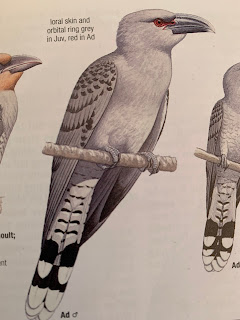
 OCTOBER: CHANNEL-BILLED CUCKOO:
These extraordinary birds look like they were created by a committee. I don't see them often and they never fail to create quite an impression. Ironically, these birds flew over as I set off on a pelagic out of Kiama. I would have expected my bird of the day (let alone my bird of the month) to be a seabird. But this flock of cuckoos, calling as they flew, were certainly worthy of the accolade. Again, this illustration is from the Australian Bird Guide. This time it is by Jeff Davies.
OCTOBER: CHANNEL-BILLED CUCKOO:
These extraordinary birds look like they were created by a committee. I don't see them often and they never fail to create quite an impression. Ironically, these birds flew over as I set off on a pelagic out of Kiama. I would have expected my bird of the day (let alone my bird of the month) to be a seabird. But this flock of cuckoos, calling as they flew, were certainly worthy of the accolade. Again, this illustration is from the Australian Bird Guide. This time it is by Jeff Davies.
 NOVEMBER: KAMKATCHA LEAF WARBLER (sometimes called simply Kamkatcha Warblers):
In November, I visited Ashmore Reef for the third time. All I wanted to see was a Nazca Booby. Of course I knew that the chances were extremely slim, but I had to try, didn't I? And of course I didn't see any Nazca Boobies. However, on Browse Island, on the way home, we found a pair of warblers. Initially we thought they were Arctic Warblers, but a sonogram of their call identified them as Kamkatcha Leaf Warblers. Again, this illustration is from the Australian Bird Guide, another of Peter Marsack's little gems. They are in fact identical to Arctic Warblers. Without Louis, we would never have known what they were.
NOVEMBER: KAMKATCHA LEAF WARBLER (sometimes called simply Kamkatcha Warblers):
In November, I visited Ashmore Reef for the third time. All I wanted to see was a Nazca Booby. Of course I knew that the chances were extremely slim, but I had to try, didn't I? And of course I didn't see any Nazca Boobies. However, on Browse Island, on the way home, we found a pair of warblers. Initially we thought they were Arctic Warblers, but a sonogram of their call identified them as Kamkatcha Leaf Warblers. Again, this illustration is from the Australian Bird Guide, another of Peter Marsack's little gems. They are in fact identical to Arctic Warblers. Without Louis, we would never have known what they were.
 DECEMBER: BLACK-NAPED ORIOLE:
How could I possibly go past this gorgeous bird for my bird of the month for December? Not only was it gob-smackingly gorgeous, it was my 850th bird. And exceptionally rare. I believe this was the second record for Australia. I saw it in the Big House garden on Home Island in the Cocos group. And I only saw it thanks to Sue Abbotts. Thank you, Sue! This photo is by Nick Thompson. Thank you, Nick!
DECEMBER: BLACK-NAPED ORIOLE:
How could I possibly go past this gorgeous bird for my bird of the month for December? Not only was it gob-smackingly gorgeous, it was my 850th bird. And exceptionally rare. I believe this was the second record for Australia. I saw it in the Big House garden on Home Island in the Cocos group. And I only saw it thanks to Sue Abbotts. Thank you, Sue! This photo is by Nick Thompson. Thank you, Nick!
 Not a bad year, I'm sure you'll agree. To get ten lifers in a year is pretty good, I think. I won't do that again in a hurry. But I can't help wondering, what exciting birds will 2025 offer me?


Subscribe to:
Comments (Atom)