Thursday, 29 July 2021

 THE 100 BEST BIRDWATCHING SITES IN AUSTRALIA:  SECOND EDITION!

I get a real buzz out of having a book published and this is my sixth!  I can hardly believe it.

I had fun writing this book.  I went through all my records and re-lived all the wonderful places I've been to birding.  What a chore.  

I made very few changes to the second edition.  Unfortunately, some sites were badly affected by the 2019 bushfires.  I felt I must downgrade both Mallacoota and Kangaroo Island, although, with any luck, if there is ever a third edition, they may regain their 'rightful' places.  Likewise, both Tidbinbilla (in the Australian Capital Territory) and Fitzroy Falls (in Morton National Park in New South Wales) have unfortunately fallen off the list.

The good news is that this left room for the inclusion of Cocos (Keeling) Islands and Lake Joondalup, both most deserving sites.  In fact, I've slotted Cocos Islands into the top ten.  I've visited these fantastic islands four times and seen an incredible 28 lifers there.  Most of these visits took place after I wrote the first edition, which is the only reason they were omitted.

Lake Joondalup is in Yellagonga Regional Park not far from Perth.  I confess I'd never heard of it until a Crested Honey Buzzard turned up there.  Now it is on every serious twitcher's To Do list.

Of course now (too late!) I realize that I should have made more changes, so that it was necessary for everyone who owns the first edition to rush out and buy the second edition.  What it is to be wise after the event.


Friday, 28 August 2020

YET ANOTHER RECORD BREAKING WALK

It is getting light earlier and the temperatures are rising slowly.  Next week is spring and I'm hoping for more record breaking walks.

This morning was sunny with a little mist on the river as I set out on my walk.  A Striated Pardalote called from the canopy; a Grey Shrikethrush made his presence felt in the bush, joined by a Grey Butcherbird in the distance.  A Magpie-lark called, a fair way off, and a White-faced Heron swore at me somewhere nearby.  My friendly Fan-tailed Cuckoo greeted me.  This bird has stayed throughout the winter, calling most days.


So my score was six before I got as far as the road.  Then three Pacific Ducks flew overhead, calling, followed quickly by a pair of noisy (but very colourful) Rainbow Lorikeets.  Some Sulphur-crested Cockatoos squawked and a pair of Crimson Rosellas flew by. Red Wattlebirds came unusually close and gave me a good look.  I usually hear these birds, but I don't always see them.  A Masked Lapwing called and I wished he'd show himself.  Ubiquitous Noisy Miners flew around the tree tops, calling, the only native bird I wish wasn't here.

Some Longbilled Corellas called, then condescended to show themselves.

I don't walk very far.  The idea is to get half an hour's exercise, so I walk for fifteen minutes, then turn back.  Since I broke my hip, I'm a little slower, so my 'half hour' walk takes 35 minutes.

I heard Pied Currawongs, looked up and, sure enough, there they were.  Below them in the same tree, sitting quietly minding his own business was a Laughing Kookaburra.  My score was now 16 and I wasn't half way yet. Not bad, I thought.

A Common Bronzewing flushed from the roadside, and a pair of Eastern Rosellas flew by, calling.  That was 18 and it was time to turn back.  My best ever walk score was 21.  I wondered if I could beat it, and started thinking of all the birds I didn't yet have on my list.  The most obvious omission was a magpie.  I felt confident I'd see or hear a magpie before I got home.  But could I manage another three to beat the record?

Then a Common Myna called.  These are the only exotics I hear regularly, and they're not as common as they used to be.  I'd be happy to have my score lessened and never see or hear them again.

Brown Thornbills scolded me from the roadside bushes and I was on 20.  This was looking like a record breaking walk alright.


I looked up (I'm not sure why) and an Australian White Ibis flew overhead.  Just the one bird, but one's enough.  Then three Black-faced Cuckooshrikes put on a performance for me, calling and chasing each other.  These were my first BFCS for August, so they were doubly welcome.  With my record broken, the eventual distant call of an Australian Magpie was a bit of an anti-climax, but he did bring my total to 23.

Little Ravens flew overhead, calling.  I've been studying their calls, refusing to be beaten by corvids.  They are difficult, but I believe most of the Warrandyte birds are Little Ravens, with just the occasional Australian Raven thrown in for confusion's sake.

Back at home,but before I entered my front door, a Grey Fantail called, ensuring he was counted.  So I had a record-breaking quarter of a century!  What will I achieve in spring?

Saturday, 1 August 2020

MY RECORD BREAKING WALK

When I posted a blog yesterday, I had no intention of doing another one today.  But when I went for my walk this morning, I recorded a record number of birds.  So I had no choice.  I had to post another blog.

Yes, I recorded 20 species of birds on my walk this morning.  Not a huge number, but it's only a half hour walk, so it's not too bad.  Of course, I've only been doing this walk since January, and was forced to take June and July off, so it's not really much of a record.  In January the largest number of birds I recorded was 16; in February it was 15, in March and April, 18 and May 17.  So 20 isn't too bad, especially as it is winter, and I didn't count that pesky unidentified raven, so really it should be 21.

I saw 3 species I didn't see yesterday:  Maned Duck (which we used to call Wood Ducks); Crested Pigeon (unusual for here) and Noisy Miner (unwelcome everywhere!).  Birds I heard this morning that I didn't hear yesterday were:  Long-billed Corella (no Little Corellas here, although they are at nearby Eltham), Common Bronzewing, Spotted Pardalote, Grey Fantail and Common Myna (thus spoiling my record of no exotic species).  When I returned home, there was a White-eared Honeyeater splashing in my bird bath and a White-browed Scrubwren playing with the fairywrens outside my window.  All pretty good for winter.

As I was walking home this morning, I heard the Crested Pigeon, but confess I didn't immediately identify the call.  I knew it was a pigeon, and our most common pigeon is the Common Bronzewing and I knew the call was not that.  I'd heard a Spotted Dove a few days ago, and I knew it wasn't that.  As I looked skyward, I saw a Welcome Swallow flying very high (a bird I would otherwise have missed from my list), then the Crested Pigeon flew into view.  As soon as I saw it, I chastised myself for not having identified its call.  Of course that's what it was!  I should have known that.  I walked a little further on, and, heard the Common Bronzewing calling too.

Keeping a bird list as I do my daily exercise was intended to make the chore less boring.  It has worked!  I now think of my walk as a birding excursion, not my daily constitutional at all.

I have found another birding game to play during this enforced lockdown monotony.  I keep a record of all the birds I see on TV.  I've only been playing this a few days and I already have quite a nice little list.  I have Greater Flamingos and a Long-tailed Widowbird in Senegal, Mute Swans and Canada Geese near London, a Marsh Harrier and a Grey Heron on the Loire and this morning I added a House Crow in Delhi.  No wonder they call us 'listers' in America!

Friday, 31 July 2020

AUGUST ALREADY!

Goodness!  It's August already!  Only one month of winter to go.

To celebrate the first of August, I decided to go for a walk.  This is the first walk I have done since I broke my hip on 30 May, so it was a bit of an adventure.  Usually, I walk every day.  I don't go far:  I walk for half an hour.  In Kew, I had four different walks I did in turn.  Here, in Warrandyte, I live on a dead-end road, so there's no choice.  I have only one walk:  up the road and back again.  Today, my half hour walk took me just over 35 minutes (and I paused to take a photo) so I was very pleased with my first effort.

I went early, hoping to avoid the dog walkers.

As I locked my front door (hardly necessary, but force of habit) I heard Striated Pardalotes calling from the gum trees.  I had a quick look, but they proved elusive.  Truth is, I wasn't game to go bush bashing.  I'm used to hearing Spotted Pardalotes here, the striated ones are not quite so common.

Then I was greeted by a magpie, then a beautiful Sulphur-crested Cockatoo landed right beside me and raised his magnificent crest just to show it off.  A Crimson Rosella called, but would not show himself.

Somehow the hill has become more steep in the few weeks I've been absent.  I struggled on, being serenaded by Red Wattlebirds and Magpie-larks.  A distant kookaburra laughed at me.  Fair enough, I did look pretty funny.  Then the world was taken over by Pied Currawongs:  dozens of them, whistling and calling from the treetops.  I was surrounded.  There was no hope of seeing or hearing anything else.

They had quietened down a little by the time I turned the corner.  A Grey Butcherbird sang his musical song.  These birds I hear often, but I see them less frequently.  This morning I was lucky.  The butcherbird sat in the sunshine, singing his heart out.

I heard ravens too.  When I was in Kew, I would have happily written down 'Little Raven' but some spoilsport told me there were just as many Australian Ravens as Little Ravens in Warrandyte.  I believe him, but I can't tell the difference.  Unless I see the Little Raven flip his wings when he alights, there're all just ravens to me.  I know Australian Ravens have gular hackles, but I can't see that as they fly overhead.  Other birders can tell the difference by their calls, but I'm afraid this eludes me.

I could hear Noisy Miners, but wasn't altogether sorry that I couldn't see them.  They remain just occasional visitors to my property.  Long may it stay that way!

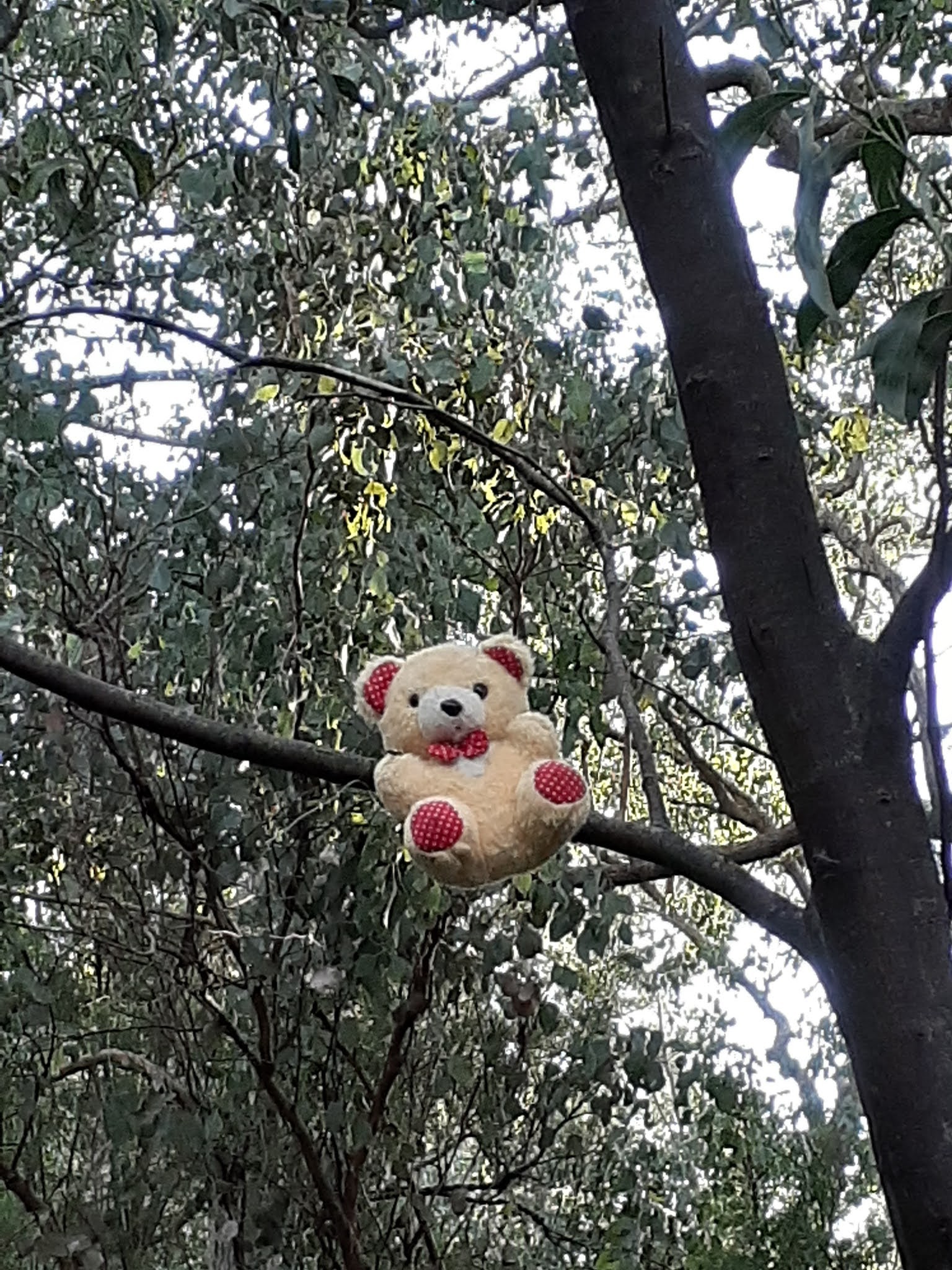
I'd seen just one other walker by the time I turned for home.  Two cars had driven past.  Two pairs of Galahs flew overhead, calling in case I hadn't seen them, followed quickly by a pair of Rainbow Lorikeets.  I like having these colourful parrots in small numbers.  They haven't taken over here, as they have in some suburbs.  Near the bend, someone had put a teddybear into a tree, bringing a smile to my lips, something we need more of in these troubled times.


I was nearly home when  pair of Eastern Rosellas flew into a nearby tree, adding a splash of colour to the morning.

Back at home, the pardalotes had stopped calling, so I didn't feel obliged to go bush bashing.  Instead, as I unlocked my front door, plovers called from the river, adding Masked Lapwing to my list.

Not a record breaking list, but I'm pleased to say that there were no exotics on it.  I usually have Common Mynas along my road, and the other day I heard a Spotted Dove calling.  Today, they were all natives.  I recorded just 14 species, not counting the unidentified raven.  I probably would have seen the same number in Kew, but there certainly would have been a few exotic species there.

Sunday, 21 June 2020

'FLIGHT LINES' by Andrew Darby

What a wonderful book!

This book should be on the must read list of every birder, every conservationist and everyone who cares about global warming.  It is essential reading.

Flight Lines is eminently readable - the first requirement I look for in a book, and one where a surprising number of otherwise good books fail.

Darby follows two Grey Plovers on their migration from Thompson Beach north of Adelaide to Wrangel Island, a tiny Russian dot in the Arctic Ocean.  On the way he pauses to give us a glimpse of his love affair with Spoon-billed Sandpipers.  There is much depressing information about mankind's efforts to annihilate waders' habitat, but yet, there is a little uplifting news too, such as the fact that China has banned reclamation in the Bohai Sea area (p. 250).

I'm sure I'm not alone in getting a thrill of seeing someone I've met mentioned in a book.  There are lots of 'names' here:  from Clive Minton to Nigel Jacket, Adrian Boyle and Chris Hassell, from Stephen Garnett to Denis Abbott.

In passing Darby notes (p. 220) that there are 828 Australian bird species.  I'd love to know how he came up with this figure.  I've seen 827 and I still have a few to go (Black-eared Catbird, White-throated Grasswren, Swinhoe's Snipe and famously, White-necked Petrel - also quite a few rarer ones such as Garganey).

If I am permitted one complaint:  it is the index.  I had thought we birders had made our opinion abundantly clear when CSIRO published 'The Australian Bird Guide' (Menkhorst et al) in 2017 and indexed Grey Plover under 'G' instead of 'P.'  To see Allen & Unwin following suit three years later is most disappointing.  We cannot allow this unbearably un-userfriendly trend to become the norm.  I am not pretending to be an expert on indexing, but I have been looking things up in indexes for over sixty years and I look for Grey Plover under 'P' not 'G'!  If he wants to be consistent, why doesn't he index Clive Minton under 'C'?  (Incidentally, I've never heard of a Dunlin being called a 'Dunlin Plover.')

It's a shame about the index.  In my opinion, this stops an excellent book from being perfect.

Saturday, 13 June 2020

BIRDING IS DANGEROUS!

On Saturday, 30 May 2020, delighted to be freed of the constraints of lockdown, I went birding.  First stop Dandenong Valley wetlands where I admired a Brown Goshawk and several Little Lorikeets.  I had really wanted to see some crakes and secretly hoped for a bittern.  However, there was nothing special.  I didn't mind.  It was wonderful to be in the field again.  I hadn't been birding since my Kiama pelagic in February.
I really wanted to see a crake.  This beautiful photo of an Australian Crake was taken by Ken Haines.

On the way home, I thought I'd call in to Jumping Creek Reserve, but the road was closed.  Later, I learnt that many reserves had been closed because people had embraced the freedom to visit parks so enthusiastically that there was overcrowding.  Appropriate social distancing was not possible and the easiest solution was to close various parks. 


Instead, I visited Koornung, which has been on my list of places I wanted to check out ever since I moved to North Warrandyte.  A pleasant bush track follows the river.  This is very close to where I live and the birds were much the same.  Lots of parrots, thornbills, honeyeaters.  Happily thinking of no more than what I'd have for lunch, I tripped on a tree root and ended up flat on my face in the mud.  Alas, I was hurt.  Turned out I broke my hip.  Into the Austin hospital (thanks to all those wonderful neighbours who rallied around and helped) where they operated on Sunday.

By Monday I was facing up to physio and by Wednesday 3 June I was home.

Whenever I start to feel sorry for myself, I look out the window.  Invariably a fairywren hops past, a spinebill flits to the birdbath or a scrubwren forages in my garden.  No medicine could aid my recovery as well as the sight of a delightful little fairywren.

Monday, 30 March 2020

MY MORNING WALK

To quote Gordon Macrae, 'Oh, what a beautiful morning!'

I've just about settled in to Warrandyte.  My daily walks are very different from my walks in Kew.  There are fewer people, no footpaths and different birds.  There is only one exotic species on my walk list:  that is the Common Myna.  Unfortunately, I see it every day.  There were more exotics in Kew.  I remember Common Starlings, Common Blackbirds, Spotted Doves.  Goldfinches were rare, but they were on the list.

This morning was dark and cold so I did not jump out of bed early as usual.  What is there to get up for at the moment?  Consequently, it was a little later when I set off on my walk.  I've always said the birds are at their best between 8 and 9 in the morning.  They certainly were today.
Crimson Rosella
There was mist along the river, but the sun was shining and the sky was blue.  A Common Bronzewing flushed from my front yard as I set off, the first of four I was to see on my walk.  A pair of Red Wattlebirds played tag in my big dead gum tree and an Eastern Rosella sat in the sun looking very colourful.  A Grey Butcherbird serenaded me and a Spotted Pardalote danced in the branches above my head.

I haven't worked out how many Magpie-larks there are in my street.  There are at least four, could be more.  I don't always see them, but I always hear them.

I don't walk far.  As in Kew, I walk for fifteen minutes, then turn back for home, giving me half an hour's exercise.  Until today, the most species I have seen on a walk was 16, which I did once in January.  Today, I recorded 18 species.  A nice way to end the month.

Australian King Parrot
I usually see both local rosellas, king parrots, cockies, Long-billed Corellas and Rainbow Lorikeets.  This morning I did not see Rainbow Lorikeets.  Nor did I see Pied Currawongs, a bird I often see, and usually hear.  I did see one lone Galah, flying overhead and squawking at me.

As usual, I heard kookaburras.  They are quite common in Warrandyte.

I had two unusual records this morning.  One was a Fan-tailed Cuckoo that I heard several times, but alas, I could not see.  The other was Brown Thornbills.  They are not rare here, but I usually see them in my backyard, not on my walk.  This morning I saw three separate flocks.  They were low in the shrubbery and very friendly.  They really wanted to get onto my list.

It was a great start to the day.  Nice to be able to say something positive in these unhappy times.