Tuesday, 18 June 2013

PORT FAIRY, PORT MACDONNELL

I had been told that if I did a pelagic out of Port MacDonnell in June, I'd be likely to see lots of prions.  Specifically, I am looking for a Slender-billed Prion.  In June 2012, Rog and I drove over to Port MacDonnell (which is in the extreme south-east of South Australia, just south of Mt Gambier) for this purpose, only to find that the trip was cancelled due to bad weather.  This year I hoped I'd be luckier.

I was - in a way.  The trip wasn't cancelled.  But I didn't get my prion either. 

We set off on Wednesday for a leisurely drive to Port Fairy.  It was cold and drizzly all day.  First stop was Point Addis to get the Rufous Bristlebird on my annual list, then lunch at Colac while we admired lots of Pink-eared Ducks and just one lonely Freckled Duck on the lake.

Thursday was again cold, wet and windy - not good weather for looking for Hooded Plovers, so we drove to Tower Hill and admired Australian Shelducks roosting on the cliff face, as if they were raptors.  Of course we saw Emus, but it was a bit wet for walking, and we didn't see much else.  Back in Port Fairy, I enquired at the Information Centre about the location of the Powling Street Wetlands, where a housing development is threatening Latham's Snipe habitat.  The helpful man gave me a map and also volunteered the fact that the snipe roost at Goose's Lagoon, a wildlife refuge on the road to Yambuk.  The Powling Street Wetlands are surrounded by houses (and presumably pets).  I have written to Tony Burke, Federal Minister for Environment asking why the housing development has been given approval.  It will be most interesting to see what response I receive.

Powling Street Wetlands, Port Fairy

Having seen the threatened wetlands, we decided to check out Goose Lagoon.  We found the place, but couldn't see how to access it.  We drove on the Yambuk Lake, and on the way saw a dam covered in Magpie Geese.  (At last I realized why Goose Lagoon was so called.)
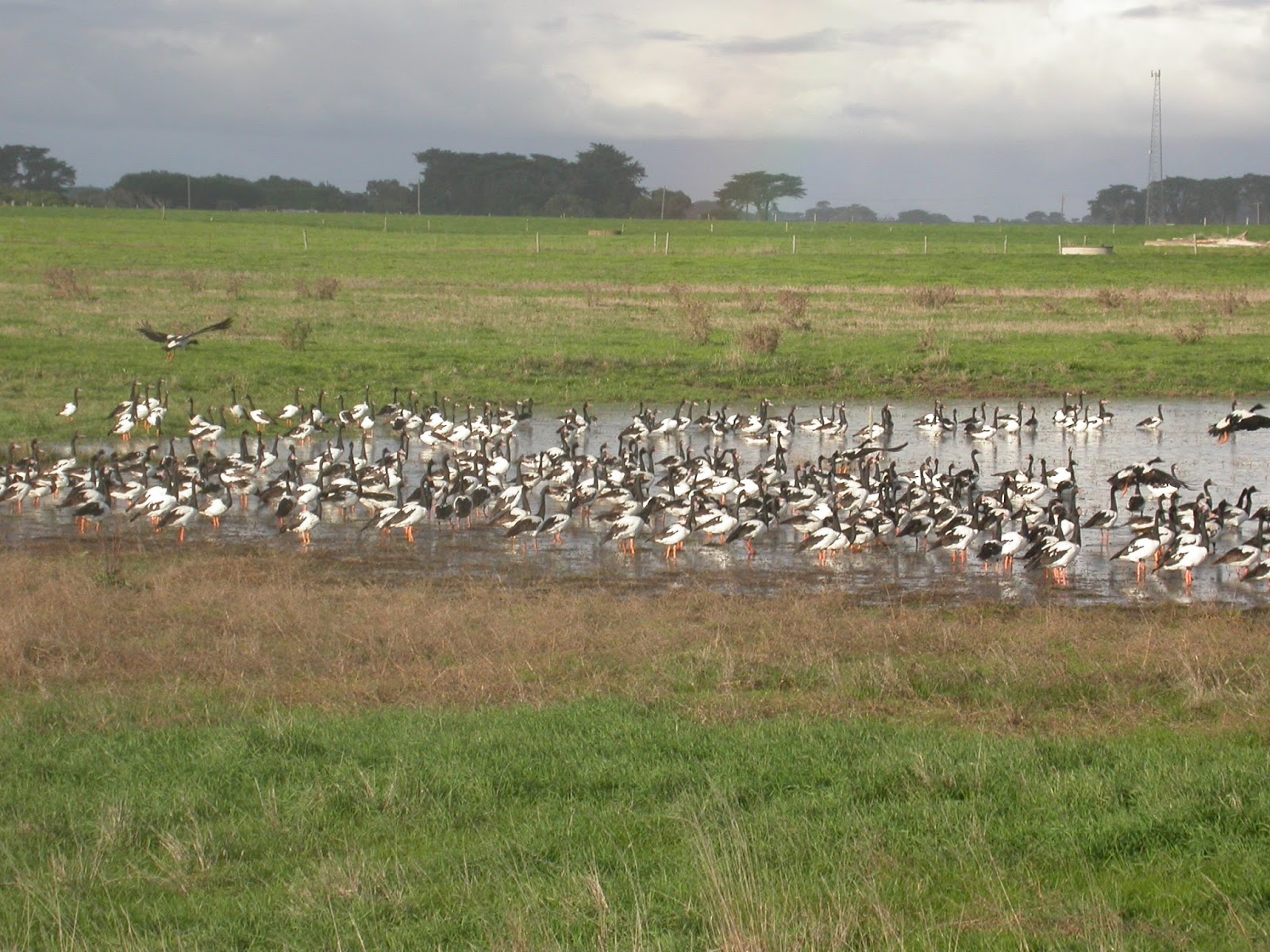
Magpie Geese on dam near Yambuk

Friday was again cold, grey and windy.  We drove to Mt Gambier, stopping at Lower Glenelg National Park.  Along the way we saw a Spotted Harrier and in the park, we saw a Brush Bronzewing and a couple of Australian Spotted Crakes on the river.

On Saturday, we pottered about Port MacDonnell.  I did a pleasant walk in Germein Reserve where the yellow gums were flowering profusely and the New Holland Honeyeaters were making the most of it.  Silvereyes, Red-browed Finches and Grey Fantails were all bathing in the puddles.  I thought it was a bit cold for a bath.

At last, it was Sunday, the day I had waited for for twelve months.  It was still quite dark when we left at 6.15.  Driving from Mt Gambier to Port MacDonnell, we saw an Eastern Barn Owl.  I hoped it might be a good omen.  The boat left right on the dot of 7.  Remarkable is a large fishing boat, with just 12 passengers, so we had good views all day.  And we saw some good birds, too; we just didn't see any Slender-billed Prions.  Most people on board saw an orca and a blue shark and everyone had great sightings of a very cooperative Grey Petrel.
Grey Petrel, photo by Geoff Glare
The petrel flew around the boat and landed near the burleigh, just to make sure everyone had a good look.
Grey Petrel, photo by Anne Looney

We saw six species of albatross, including two wanderers, both giant-petrels and quite a few Grey-backed Storm-Petrels.  Some people saw a Little Shearwater, but for me it was just a tiny dot on the horizon.  We saw a few Fairy Prions, and I tried my best to turn them into Slender-billed.  There were Cape Petrels and one White-fronted Tern.  I managed twenty species for the trip (not counting the Little Shearwater).  Can you believe, they actually provided a barbeque for lunch?

Monday was again raining.  I told myself not to complain, it was, after all, winter.  However the sun did manage to put in an appearance.  In Nelson, we saw a Great Crested Grebe and at Lower Glenelg National Park I saw a Baillon's Crake in the river.  Then in Portland, at Fawthrop Lagoon, I saw a Little Egret, another new bird for the trip.

On Tuesday morning, before we drove home, I made one last attempt at getting Hooded Plovers on my list.  I was not successful, but I did see a Sooty Oystercatcher, bringing my trip total to 115 species, which, given the unfavourable conditions, I thought was okay.  It looks like I will have to try for my Slender-billed Prions again in 2014.  What a shame!  An excuse for another trip to Port MacDonnell.

Friday, 7 June 2013

ROYAL PARK, PARKVILLE

My nephew and I both have birthdays in early June, so we decided that a joint celebratory lunch was in order.  We chose a restaurant in Carlton, which meant I could spend an hour or so in nearby Royal Park beforehand, looking for Swift Parrots.  These endangered parrots have been reported here just once this year, a fortnight ago.

These birds are in trouble.  It is estimated that the total population is 1,000 pairs.  They breed in Tasmania in summer and spend the winter on the mainland.  So far this winter, there have been just three reports in Victoria:  on 21 May, two birds were seen in Royal Park; on the same day three birds were seen at Crusoe Reservoir in Bendigo; and on 30 May, four birds were seen in the You Yangs.  As I set off, scanning all the flowering eucalypts in Royal Park, I knew that my chances of seeing Swift Parrots were not good.

I'd seen Swift Parrots in Royal Park in June 2011, in a eucalypt near the tram tracks.  Perhaps irrationally, I headed for that tree.  There were lots of raucous Rainbow Lorikeets making their presence felt, living up to my Third Law of Birdwatching:  'The more gorgeous a bird's plumage, the less melodious the song; and conversely, the more drab the plumage, the more mellifluous the song.'  It was grey and cold, with no sunshine.  I managed to avoid the golfers, but sadly, I also managed to avoid the Swift Parrots, if indeed there were any there.

Rainbow Lorikeets live up to Sue Taylor's third law of birdwatching.  Photo:  Jim Smart.

I wandered through the park to Trin Warren Tam-boore, totting up a total of 25 species, not altogether bad for a grey winter day in a city park.  I saw plenty of Roger's favourite honeyeater, the New Holland, several overactive Eastern Spinebills and one spectacular Spotted Pardalote, conveniently at eye-level.  There was too much water in the wetlands and I saw no ducks.

I put the absence of Swift Parrots behind me, and turned my mind to celebrating the fact that both my nephew and I had survived another year on this planet.  Happy Birthday, Nephew!

Thursday, 6 June 2013

REGENT HONEYEATERS AND MORE

Just back from a couple of great days birding.  We stayed in Wodonga, and spent most of our time in Chiltern.  We left on Tuesday morning.  I had Brown Thornbills playing outside my bedroom window before we left, despite the grey winter weather.  I thought that was a good omen.  We drove to Nagambie to buy walnuts (the best!) then had lunch at our favourite spot: Fowles winery.  Then it was on to Winton Wetlands, which is one of my top 100 birdwatching sites.  We admired half a dozen male Flame Robins sitting on fence posts looking absolutely splendid, then quite a large flock of Zebra Finches and, finally, some beautiful Diamond Firetails.  They flew across the road in front of the car and I asked Rog to go back, so I could confirm their identification.  Most patiently, Rog complied, and we both enjoyed lovely views of the firetails sitting on the fence and on the roadside verge.
Diamond Firetail taken by Jim Smart

On Wednesday, our first stop was Chiltern Park.  This is a roadside stop on the freeway, just north of Chiltern.  It is actually part of the Chiltern-Mt Pilot National Park, and the birding is always good.  Very soon, you don't notice the noise from the highway traffic close by.  Highlights this morning were several male Scarlet Robins and one darling female Speckled Warbler.  I was delighted to note that many of the ironbarks were flowering prolifically.  I could hope to see Regent Honeyeaters.  Next, we went into the Mt Pilot section of the national park and drove up and down McGuiness Road, hoping for Spotted Quail-thrush.  Sadly, not today.  Then we went to Bartley's Block, where Red Wattlebirds and Noisy Friarbirds predominated.  There were also Golden Whistlers, Eastern Spinebills and a Mistletoebird.  I had always thought that Mistletoebirds were migratory, arriving in Victoria when mistletoe fruits, breeding in summer, then returning north in autumn.  I was surprised to see a handsome male in June.  The only field guide I had with me was Simpson & Day, which classified them as 'sedentary?' so I was none the wiser.  Now I am home, I have checked my records, and they show that Mistletoebirds were always absent in winter from my parents' north-central Victoria home.  I don't think the north-central Victorian Mistletoebirds could be described as 'sedentary.'

Then we drove up Fishers Lane looking for Grey-crowned Babblers.  I had seen them recently in Alice Springs (on my Forest Wagtail twitch) and admired their rich rufous breasts.  The eastern race lacks this colourful breast.  I wanted to see this race and try to remember the difference.  But there were no babblers to be seen here today.

Then we drove into the national park again and saw a couple of cars and two people in the bush and three standing beside the road.  Natually I stopped to ask if they'd seen any Regent Honeyeaters.  Of course, they had.  I introduced myself to Dean Ingwersen from BirdLife Australia, in charge of the Regent Honeyeater recovery program.

Regent Honeyeater, photo thanks to Jim Smart

Dean was radio tracking Regent Honeyeaters that had been bred at Taronga Park Zoo and released in the park last April.  He said there were 14 birds hereabouts.  We saw four.  And extremely beautiful they were too.  No illustration ever seems able to do justice to these birds.  (Sorry, Jim!  It is a lovely photo!)  Although the ironbarks were flowering profusely, the honeyeaters were feeding on insects.  They landed on the trunks of the ironbarks (as if they were treecreepers or robins) and gleaned insects from the bark.  They were all wearing colour bands, but, although we were not far away, I could not identify the colours.  I could have spent hours with Dean, but, after we'd had great views, Rog said it was time to move on.

We visited Frog Hollow, Greenhill Dam, then Honeyeater Dam in Cyanide Road.  The honeyeaters were wonderful (at least seven species).  For a splash of yellow (as well as the Yellow-tufted Honeyeaters) there were Eastern Yellow Robins, Golden Whistlers and Crested Shrike-tits.  Brown and White-throated Treecreepers frolicked side by side.

We visited the other sites (No 1 and No 2 dam, the swamp near the Rutherglen tip and Black Swamp) but we saw nothing more of note.  It was, after all, very wintery.  The sky looked as if it were trying to rain, but couldn't quite make it.  We finished the day with 68 species, which is not too bad for winter.

On Thursday, we visited Wonga Wetlands before we turned homewards.  Yes, Wonga Wetlands is also one of my top 100 birdwatching sites.  I was hoping for egrets.  I needed both Little and Intermediate for my 2013 list.  But, although there was more water than on our previous visit, water levels were still quite low and there were not the water fowl numbers that I'd hoped for.  I saw Australasian Shovelers for the first time here.  Not a rare bird, but I hadn't seen them here before.  There are always Yellow Rosellas, and coots and swamphens and moorhens, but there were not as many passerines as usual today.

It was time to go home.  We had a respectable 94 species, which, I think, is not too bad for winter.

Monday, 27 May 2013

Northern Shoveler

There is one male Northern Shoveler at Melbourne's Western Treatment Plant.  He's lost his way from the northern hemisphere and taken up residence amongst our local ducks.  Each winter, thinking that it's the northern hemisphere summer, he dons his breeding plumage, and his white breast stands out amongst the other ducks.  Otherwise, in eclipse plumage, he blends into anonymity.  I first saw him in May 2004, when he appeared at a part of the farm where birders are not allowed to go.  A few keen twitchers were guided into this restricted area by Melbourne Water's resident ornithologist.  And a great day we had too.  (Let's face it, any day you get a lifer is a great day.)  Then in August 2011, he put in another appearance.  That year, I saw him in the sea, from the bird hide.  This year he appeared in Lake Borrie, and sightings of him were sufficiently regular to entice a birdy friend down from Sydney to twitch him.
See the white dot?
So yesterday, we set off for Werribee with our Sydney friend in search of a Northern Shoveler. And this is what we saw on Lake Borrie with the naked eye.  Trust me, there is a white dot in the centre of the photo.  You'd be lucky to see him without a scope.  This is what he really looks like:
Northern Shoveler

No, I didn't take this photo at Werribee.  He is a beautiful bird, well worth a flight down from Sydney. 

There were quite a few people at Werribee yesterday, attracted by the possibility of seeing a Northern Shoveler.  There was some drizzle in the morning, but there was little wind and the birding was great.  Once we'd ticked our target species, all stress had gone and we settled down to enjoy ourselves.

We managed 70 species for the day.  Yes, I know others achieve 100 without any effort, but this is May, and I was quite happy with 70.  As usual, we saw plenty of raptors.  There were lots of Black-shouldered Kites, Swamp Harriers, Brown Falcons and Whistling Kites.  We had wonderful sightings of a Spotted Harrier and a White-bellied Sea-Eagle sat atop the artificial forest, surveying his kingdom.  Banded Stilts have taken up residence at Werribee at the moment and have pushed the Black-winged Stilts into the sea.
Banded Stilts at the Borrow Pits

Banded Stilts are very handsome birds.  I'm delighted to be able to enjoy them at Werribee.  We had great views too of Striated Fieldwren (at the gate near the boat ramp on Beach Road) and Little Grassbirds, which I hear much more often than I see.  We saw a few Australian Spotted Crakes and some sweet Zebra Finches.

We went home very happy with our day's birding, and, needless to say, our Sydney friend was delighted with his tick.

Friday, 17 May 2013

FOREST WAGTAIL REVISITED

Forest Wagtail by Brian Johnston
When I wrote of my visit to Alice Springs, I did not have any decent photo of the dear little bird that drew me there, so I posted one I'd taken myself.  Now, thanks to Brian Johnston, I do.  Brian was there enjoying the bird at the same time as I was and he has kindly sent me some photos to share with you.

Mike Carter was there too.  The Forest Wagtail was his 858th Australian bird!  (And here's me thinking 700 was pretty good!)

Mike wrote:  'It was a joy to watch the Forest Wagtail at close range walk in a deliberate and unhurried manner, wave its tail in a horizontal rather than a vertical plane, search for food in the shadows, eat a large caterpillar, take a long bath scattering water widely and then preening at length on the ground and in a tree.  All this in the pleasant surrounds of a landscaped but surprisingly small garden and in the convivial company of the host and five others of like mind sharing the experience.  It was great!'

Forest Wagtail by Brian Johnston
Here's the bird with the large caterpillar Mike mentioned.  It was quite spectacular watching the bird eat this huge meal, squirting its stomach contents over the lawn.  As I said previously, this was the first time I've ever jumped on a plane to see a rare bird.  I doubt it will be the last.

Forest Wagtail by Brian Johnston
Thank you, Brian, for the beautiful photos!  I'm sure we all appreciate them.

Thursday, 9 May 2013

TWITCHING THE FOREST WAGTAIL

The Forest Wagtail is a very pretty little bird.  It breeds in southern China, then migrates to Asia.  Last week one turned up in a suburban back yard in Alice Springs.  Of course I had to go and see it.

Forest Wagtail, Alice Springs, May 2013

Yes, I know it's a lousy photo, but at least it proves I saw the bird!

This is the first time I've ever jumped on a plane to go to see a vagrant.  Yes, I drove to Paynesville for the Franklin's Gull last November, and I just happened to be near Sydney when the American Golden Plover was sighted at Kurnell in March 2009.  But I've never before flown interstate to twitch some hapless vagrant.  Now I can count myself a fully fledged twitcher.

I heard about the bird on Monday, but was busy indexing my next book and couldn't get away until Wednesday.  I arrived in The Alice just after 11 on Wednesday morning.  Within a couple of hours, I'd had great views of this dear little Asian bird and added another tick to my life total.  Mike Carter (Australia's best birder) and his charming wife, Patricia, were on the same plane from Melbourne and kindly gave me a lift to the b & b where the bird had been seen.  A small group of avid twitchers had arrived to witness this special little bird.  The Forest Wagtail obediently put on quite a show, walking around the garden, splashing in some water, eating an enormous caterpillar in rather spectacular fashion and living up to its name by wagging its tail, which in fact was more like moving all of its lower body, not just its tail.

I thought it was much prettier than the photos on the web had shown, and more colourful.  I'd expected a black and white bird, but it had a warm pale brown back and some pale lemon on its throat.  Of course I thought it was pretty.  It was a beautiful, unexpected tick.

Sunday, 5 May 2013

WOLLONGONG AND GIPSY POINT

On the way back to Melbourne from our trip to Port Stephens and Barrington Tops National Park, I planned two stops:  Wollongong for a pelagic, then a couple of relaxing days birding at Gipsy Point.  Both these spots feature in my top 100 Australian birding sites.

This was the third pelagic I'd booked in 2013, but the first to actually go.  The weather was perfect.  I was delighted that the boat was only half full, so I had excellent, unblocked views all day.  We did not see a lot of species (I recorded 17) but we certainly saw a lot of albatrosses.  At one point there were over 50 surrounding the boat.  They were mainly Black-browed and Shy, but there were also Campbell's, Yellow-nosed and Buller's.

Banding a Yellow-nosed Albatross

Wollongong pelagics are run by SOSSA - the Southern Ocean Seabird Study Association.  On this trip they banded shearwaters (Flesh-footed and Wedge-tailed) and Yellow-nosed Albatrosses.  We saw both Pomarine and Arctic Jaegers, the latter identified by its aggressive behaviour.  The only petrel we saw was a Providence (that the New South Welshmen insist on calling 'Solander's') and the only Storm-Petrel was a Wilson's.  I think everyone on board would agree that it was a very pleasant day at sea - not something you can often say about a pelagic.

And then it was off to Gipsy Point in far east Gippsland.  The best bird I saw on the way was a Brahminy Kite.  I've never seen one so far south before.

At Gipsy Point we stay in the (modestly named) Luxury Lakeside Apartments.  The name may not be humble, but neither is the accommodation.  This is one of my very favourite places.  They feed the birds each evening and afternoon.  Galahs, King-Parrots and Little and Red Wattlebirds screech overhead.  Eastern Whipbirds play on the lawn, quite unafraid of people.  A Buff-banded Rail was on the lawn right out in the open when we arrived.  Sometimes there are frogmouths roosting in the eucalypts, and sometimes White-headed Pigeons.  There are always Bell Miners and Red-browed Finches, kangaroos and swamp rats.  I always take some blue treasures as offerings for the Satin Bowerbird.  He accepts my gifts, I like to think gratefully.

We always drive into Mallacoota to see what we can see at Captain Stevenson's Point (on this occasion, there were teal, terns, godwits, oystercatchers and Eastern Curlews).  I do as many walks as I can.  I was delighted to see that a new coastal walk has been constructed for me to add to my list.  I usually do Double Creek (looking for Wonga Pigeons and lyrebirds); Heathland (hoping for Ground Parrots, which I have never seen here); and Casuarina Walk for bush birds.  In Mallacoota, we saw a pair of Glossy Black-Cockatoos sitting on the electricity wires.  They did not hang around for a photo, but we were happy to have seen them.  We had thought that April may have been too late, and they may have left on their northern migration.  Sadly I could not find any Hooded Plovers on Betka Beach, usually a reliable sighting.

We often drive to Shipwreck Creek to look for Southern Emu-wren, Ground Parrots and Tawny-crowned Honeyeaters.  I've heard the parrots here, but not seen them.  I figure if I keep on going, one day I'll luck onto them.  I see emu-wren more often than not, and I don't think I've ever dipped on the TC honeyeaters - until this trip.  On this occasion, I did not see any of my target species.  I did see a lyrebird (they featured in this holiday - I saw lots!) and a Bassian Thrush, but that was all that was noteworthy.

Outside of school holidays, there are not many better birding spots than Gipsy Point and Mallacoota.

Little Black Cormorants at Mallacoota