Monday, 30 December 2024

BIRD OF THE MONTH 2024

My awards for the Bird of the Month 2024 are as follows: JANUARY: TAWNY FROGMOUTH: I've always loved Tawny Frogmouths and I try to get them onto my birdlist every month. I have a couple of local spots I check every month, but if these birds let me down, I go to Blackburn, where I'm usually successful, or Royal Park. This photo was taken in Royal Park by Peter Petinatus.
FEBRUARY: RED KNOT: The Red Knot is not a rare bird, but it is one I don't often see. In February I saw them at Werribee, hence it became the Bird of the Month. This beautiful photo is by David Hollands. I took it from 'Waders, The Shorebirds of Australia' by David Hollands and Clive Minton. The Red Knots really stand out. The ones I saw at Werribee were not in breeding plumage, and did not stand out. They melted into the background of other anonymous waders. The photo also shows Grey-tailed Tattlers, Sand Plovers and Curlew Sandpipers.
MARCH: MANGROVE GERYGONE: I saw this bird at Wynnum Mangrove Boardwalk in Brisbane, where Rae Clark took me birding. (Thank you, Rae!) Although it is not rare, it is a bird I do not see every year and it is a dear little thing, I'm sure you'll agree. I sometimes think it has been mis-named: I don't see them in Mangroves. I see them in paperbarks, adjacent to Mangroves. This photo is Peter Marsack's illustration in the Australian Bird Guide.
APRIL: WESTERN SHRIKETIT: My first lifer for the year. I put in some effort for this bird, then, when I saw it, it couldn't have been easier. It was at the traditional spot, by the water feature at the Stirling Range Retreat, right on cue. I had looked for it on a previous visit to Western Australia, and failed, so this was a special trip to the other side of the continent. And well worth it too. I don't think the Western Shriketit is as pretty as our Eastern one, but a tick's a tick in anyone's language. Des Hume showed me this bird and took this photo. Thank you, Des.
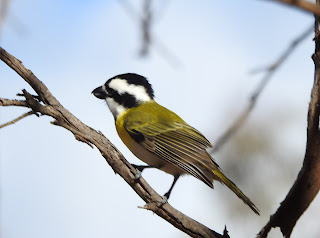
MAY: HOODED ROBIN: Hooded Robins bred every year on my parents' property in north-central Victoria. I was with my parents the day they decided to buy the property, and I reckon it was a Hooded Robin that clinched the deal! I love all those birds of the box/ironbark countryside. Hooded Robins in particular always remind me of my parents' place. In May, I saw them in the Warby Ranges, on my way to check out the birds of Chiltern. Again, I took this illustraion from the Australian Bird Guide. It is another of Peter Marsack's lovely images.
JUNE: SANDHILL GRASSWREN: I saw this bird in June, but it was not split by the IOC until July. Louis Masarei showed it to me at Sandstone in WA. I have been unable to find an illustration of it. JULY: SUPERB LYREBIRD: My birdy friend, Helen Yuille, wanted to see a lyrebird. With great confidence, I said I'd show her one. Of course I'd seen them countless times. And I reckon I could find one easily enough in far east Gippsland. But where could I guarantee to find one a short drive from of Melbourne? I thought perhaps Healesville, but (after consulting some people who know a lot more than me) decided on Sherbrooke. Helen and I found the recommended track and heard lyrebirds almost immediately. Then we saw them: I think we saw three altogether, but one bird in particular put on an impressive display. Mission accomplished!
AUGUST: TIBETAN SAND PLOVER: In August I had my third trip to Western Australia in 2024 and my third lifer for the year. I got this bird thanks to Louis Masarei. Thank you, Louis. I saw them again on Cocos (South Island, on the Saunders's Tern hunt), but it wasn't nearly as exciting as making a special trip to Broome for the tick. This photo was taken on Cocos by Richard Baxter. The Tibetan Sand Plover is the bird on the left.
SEPTEMBER: OLIVE WHISTLER: I visited Tasmania in September with my birding mate, Ken Haines, with the sole purpose of going on a pelagic. The pelagic was cancelled and so we made do with a little Tasmanian birding. It was very windy, (guess why the pelagic was cancelled!) and the birds refused to cooperate. However, a couple of Olive Whistlers put on quite a show for us. I enjoyed it very much. I'm not sure I'd say it made the trip to Tasmania worthwhile, but it was certainly fun. Ken took this photo.
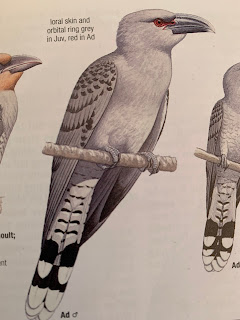
OCTOBER: CHANNEL-BILLED CUCKOO: These extraordinary birds look like they were created by a committee. I don't see them often and they never fail to create quite an impression. Ironically, these birds flew over as I set off on a pelagic out of Kiama. I would have expected my bird of the day (let alone my bird of the month) to be a seabird. But this flock of cuckoos, calling as they flew, were certainly worthy of the accolade. Again, this illustration is from the Australian Bird Guide. This time it is by Jeff Davies.
NOVEMBER: KAMKATCHA LEAF WARBLER (sometimes called simply Kamkatcha Warblers): In November, I visited Ashmore Reef for the third time. All I wanted to see was a Nazca Booby. Of course I knew that the chances were extremely slim, but I had to try, didn't I? And of course I didn't see any Nazca Boobies. However, on Browse Island, on the way home, we found a pair of warblers. Initially we thought they were Arctic Warblers, but a sonogram of their call identified them as Kamkatcha Leaf Warblers. Again, this illustration is from the Australian Bird Guide, another of Peter Marsack's little gems. They are in fact identical to Arctic Warblers. Without Louis, we would never have known what they were.
DECEMBER: BLACK-NAPED ORIOLE: How could I possibly go past this gorgeous bird for my bird of the month for December? Not only was it gob-smackingly gorgeous, it was my 850th bird. And exceptionally rare. I believe this was the second record for Australia. I saw it in the Big House garden on Home Island in the Cocos group. And I only saw it thanks to Sue Abbotts. Thank you, Sue! This photo is by Nick Thompson. Thank you, Nick!
Not a bad year, I'm sure you'll agree. To get ten lifers in a year is pretty good, I think. I won't do that again in a hurry. But I can't help wondering, what exciting birds will 2025 offer me?

Sunday, 15 December 2024

MY 850TH AUSTRALIAN BIRD

I've just returned from Richard Baxter's Cocos/Christmas Island tour. To summarize this particular 2024 trip, Christmas was disappointingly wet with no lifers for me, but Cocos excelled itself, providing me with six lifers, including my milestone 850th Australian bird, an incredible Black-naped Oriole!
There were 15 of us on this tour, some who'd never been before and some veterans of many trips. I'd been to Cocos seven times; Christmas eight times. We arrived on Friday 29 November and the ony bird of note we saw that day was the Northern Pintail at the birdhide, together with some of its hybrid offspring, some resembling it and some resembling Pacific Black Ducks. On Saturday, several of our group, including me, took the ferry to Direction Island because there were reports of a Cinnamon Bittern there. As the ferry didn't leave until 9.30, we had plenty of time for some birding beforehand. We drove the length of the island checking the sides of the road to see if anything had flown in overnight. It hadn't. However, at the farm I saw my 847th Australian bird: a Dark-sided Flycatcher. I reckon I'd earnt this bird: I spent a week looking for it on my last trip to Cocos in November 2023. I sat in the heat watching the bush it had been seen in for hot day after hot day, with no joy at all. Now here it was at the farm, happily flying over our heads, and drawing attention to itself, always returning to the same perch. I was quite delighted to get a lifer so early in the trip and to see a bird that I'd worked hard for previously and reckoned that I'd earned. This photo is by Bernie O'Keefe.
Seeing the flycatcher lessened my disappointment at not seeing the Cinnamon Bittern on Direction Island. Richard (who'd stayed on West Island with the rest of the group) contacted us to say that one of our group had photographed an Indian Cuckoo! That's the luck of birding. We'd taken a gamble and gone looking for a Cinnamon Bittern when we'd have been better off staying with the group and seeing an Indian Cuckoo. This is the second record of this bird for Australia: a bird was seen on Cocos in February 2011. We returned to West Island and searched diligently for the cuckoo. We admired David's photo and said we were pleased for our companions. Then Geof Christie, resident birder on Cocos, reported 'a strange little orange duck' at the birdhide. We drove there immediately and saw the bird straight away. It was in front of the birdhide, constantly feeding, never still for a second, quite a contrast to the lazy, loafing Pacific Black Ducks around the pond. Graham Barwell (one of our group) identified it as a female Eurasian Wigeon, (848), a bird I thought I'd never see and didn't really deserve to as I hadn't bothered to twitch the one that turned up at Carnarvon some years ago. This photo of the wigeon is again by Bernie O'Keefe (thank you, Bernie!)
We also saw a Chinese Pond Heron, more excitement for the first timers. In the late afternoon we were celebrating our success in the club, when Jenny Spry (Australia's number one female birder, also a member of our group) arrived to announce that a Cinnamon Bittern had been seen at the farm. People who know me would be amused to learn that I abandoned my glass of wine and ran out immediately in search of the bittern. Sue Taylor abandonning her wine is not an everyday occurrence. Six of us rushed to the farm. We floundered around in long grass in a disorganized fashion. The outcome was predictable: three of us saw the bittern, three did not. I did not. The light was failing and we were forced to call it a day. I painted a smile on my face and pretended to be pleased for my successful companions. On Monday morning before we caught the ferry to Home Island, we all went on a cuckoo hunt. We had looked the previous morning and failed once more. This time we were successful. That lovely little Indian Cuckoo became my 849th Australian bird. This photo is by David Charley.
On Home Island, our first exciting bird was a Rosy Starling. Again, thanks to Bernie for this photo.
Sue Abbotts, a fantastic Western Australian birder with a phenomenal Australian total well over 800, found a Blue and White Flycatcher. Later she was to find a Mugimaki Flycatcher (which I did not see), as well as her undeniable triumph: a Black-naped Oriole, which, I'm delighted to say, I did see, but only after a considerable time spent looking, and only after a bit of help from Matt Hansen. These birds live in Asia and I couldn't think of a better candidate for my 850th milestone slot. I took this photo from 'The Birds of Java and Bali' by Derek Holmes & Stephen Nash.
Just to continue my extraordinary record of one lifer per day, on Wednesday, Richard took us to the farm, and everyone had at least a fleeting glimpse of the Cinnamon Bittern (851). It was a dark bird, hence declared to be young, with some early discussion about whether it might be a von Schrenck's Bittern instead. But unambiguous views of its rufous flight feathers confirmed its identity as a Cinnamon Bittern, another bird I convinced myself I'd earned, because on a previous occasion a Cinnamon Bittern had been seen on Cocos every day while I was on Christmas Island. It was wandering along the grass verge beside the road, unafraid and out in the open, and this, evidently, was its undoing. It was killed by a cat (rumoured to be owned by a park ranger!). Anyway it was quite dead by the time I arrived on Cocos. Somehow, this made seeing this Cinnamon Bittern even more special. On Thursday, I broke my pattern of daily lifers. But on Friday, I returned to form. In the farm (where else?) we all had great views (after a fair bit of waiting and looking and a great deal of hard work and patience on Richard's behalf) of a Pallas's Grasshopper Warbler. Here's a photo Bernie took, not on Cocos, but on Ashmore Reef some time ago. It's a terrific photo of a Pallas's Grasshopper Warbler, showing its long legs, a feature few people actually see as it zips past or skulks away invisibly.
One last photo of Bernie's I must include, because Watercocks are not on everybody's lifelist. They are not often present and when they are, they often flush fast and people don't get a good look.
Quite a trip, I'm sure you'll agree. And I haven't mentioned any of the 'ordinary' birds. Birds like the Christmas Boobook, the Golden Bosunbird, Abbott's Booby or Christmas Frigatebird. Thank you, Richard! I'll be back!

Tuesday, 12 November 2024

ASHMORE REEF

When I visited Broome in August to twitch the Tibetan Sand Plover, I learned that a Nazca Booby had been seen on the Lacepedes. I confess that I'd never heard of a Nazca Booby. I quickly discovered that it was a recent split from the Masked Booby, with an orange (not yellow) bill and olive (not yellow) feet. It normally lives in the vicinity of the Galapagos. Now that's a fair way from the Lacepedes. Why wasn't the birding world agog at this extraordinary news? It seemed to be a well kept secret. Louis showed me a photo. It certainly seemed legit. The only way I know to get to the Lacepedes is to do George Swann's 10 day boat trip to Ashmore Reef. I decided I had no option but to try for it, so I put my name down for the November Ashmore Reef trip. I'd done this boat trip before. It leaves from Broome, travels to Ashmore Reef, visits West, East and Middle Islands and Splittgerber Cay, then calls at Browse Island and the Lacepedes on the way back to Broome. Of course I knew the chances of seeing the bird were slim, but I figured I had to at least try and I certainly wasn't going to see it sitting at home in my lounge room.
I studied the birdlists. There were 14 species which had been seen on Ashmore Reef which I'd never seen, but, being realistic, I wasn't going to see a Lesser Coucal, which had been happened across just once in over 30 trips. I reckoned my best chance of seeing something new was the Collared Kingfisher. This had been seen on 49% of previous trips - that's as good as a fifty/fifty chance. I remembered looking for it on earlier trips: it is slightly larger than a Sacred Kingfisher with a white breast (not buff), blue upperparts and cap (not greenish/blue) and a white loral spot. I remembered Sacred Kingfishers being very common on West Island, and peering at each one trying desperately to turn its breast white and to create a white loral spot. With no success of course. George soon disabused me of any hope I had: Collared Kingfishers had not been seen for some time. The chances of seeing one were minimal. News of the Nazca Booby was even worse. The bird on the Lacepedes had been seen just once, over a year ago. No one had been there since. A Nazca Booby had also been seen on Middle Island. Once. In the company of Brown Boobies. And another bird had been seen somewhere near Papua! Perhaps it was all the same bird. Perhaps there were three. Who knows? My heart sank as it dawned on me that I was not going to see a Nazca Booby. Or a Collared Kingfisher.
We left Broome on Friday, 1 November and arrived at West Island on Sunday afternoon. There were some good seabirds along the way. Apart from boobies, terns, noddies and frigatebirds, we saw Streaked Shearwaters and Tahiti Petrels and I was pleased to see Bulwer's and Joanin's Petrels, and Swinhoe's and Matsudaira's Storm Petrels. Unusual sightings at sea were one Eastern Yellow Wagtail and one Edible Nest Swiftlet. On West Island, as expected, there were waders, frigatebirds and boobies, Buff-banded Rails, Nankeen Night and Pacific Reef Herons. We also saw lots of Oriental and Horsfield Bronze Cuckoos, I think just one Brush Cuckoo, more than one Barn Swallow, several Island Monarchs, I think more than one Supertramp Fantail and an Asian Brown Flycatcher. At least three pairs of Red-tailed Tropicbirds were nesting on the island. Both CSIRO and Monash are working on the island. CSIRO is attempting to remove the buffle grass (the photo shows plants bagged for removal and destruction) and installing boards for Asian gheckos to inhabit so they can be removed.
While we were there, Monash installed 30 nest shelters for Red-tailed Tropicbirds.
We visited West Island several times, East and Middle just once. At Splittgerber Cay, I needed help navigating what was really very shallow water.
Browse Island was very hot. Access is difficult because of the surrounding reef, so we spent more time waiting for the tenders to come and pick us up than we'd intended. For me, the highlight of the trip was two very cooperative Kamchatka Leaf Warblers on Browse. We initially thought they were Arctic Warblers, but a sonogram of the call confirmed they were Kamchatkas. Either species would have been a lifer for me, so I was delighted. I was, of course, disappointed at the absence of Nazca Boobies, but I'd always known it was a long shot. And a lifer is a lifer after all. One I would not have seen had I sat at home in my lounge room.

Tuesday, 29 October 2024

KIAMA PELAGICS

It seems a very long time since I've been on a pelagic. In fact, it's been seven months. Last March, I did a Southport pelagic, hoping for a New Caledonian Storm Petrel. I will hope for one again next year. I'd booked to do back-to-back pelagics out of Kiama in October and I particularly wanted to go because I knew it would be my last SOSSA trip. I've been doing pelagics with the Southern Ocean Seabird Study Association for many years and have enjoyed the company of the experts on board and learnt a great deal from them all. SOSSA has decided to dissolve itself and it will be sorely missed. Lindsay Smith has been synonomous with SOSSA and I will certainly miss his endless patience and tolerance of my ignorance. I needed to say goodbye and thankyou for his years of patient assistance. His wife, Janice, also deserves great appreciation for her organization skills. Where would we have been without them? I met many seabird experts on SOSSA trips, mainly on the 'Sandra K' out of Wollongong, once on the MV Banks out of Ulladulla, and more recently on the 'Kato' or 'Kiama' out of Kiama. And I've made several good friends, most notably Brook Whylie (who established this blog for me) and Graham Barwell, who has found me several lifers over the years. Their knowledge of seabirds is extraordinary. Thank you, SOSSA!
My photographer mate, Ken, was to accompany me to Kiama. We left early on Thursday, both eager to get out to sea after our unsuccessful trip to Tasmania in September. We drove straight to Gerroa, not too far from Kiama, where we'd stayed last time we'd done a Kiama pelagic in February 2023. On Friday we birded at Jerroa Dam, where, in my very limited experience, the birding has always been good. I declared the Black-faced Monarch to be the Bird of the Day. Saturday morning saw us standing on the Kiama wharf, eager to get out to sea. Alas, there was an atmosphere of gloom, and we did not pay as usual before we boarded the boat. This was because three metre swells were forecast, and the captain expected us to be returning to shore very soon. If we made it to the shelf, we could pay later. So it was with mixed emotions that we set off. I was cold at the start and gradually got colder all day. We did make it to the shelf. We saw lots of birds. It wasn't a bad day at all. Others complained it was rough; I didn't think it was especially bumpy. Two people were seasick. I saw 17 species, which isn't bad. Everyone was excited by a Grey-backed Storm Petrel (unusual for NSW, not too hard in Tasmania). I didn't realize until I got back home that the White-chinned Petrel we saw was my first for NSW. We saw Black-browed and Shy Albatross, and a large number of Buller's. In fact they banded a Buller's. This photo is by Ken Haines, not taken on this trip, but still a nice picture of the bird.
There were Australasian Gannets of course, and three confirmed species of shearwaters (Flesh-footed, Short-tailed and Wedge-tailed) as well as one fluttering-type. One Brown Skua flew past, and a few Grey-faced Petrels put in an appearance. Several individual Wilson's Storm Petrels flew by throughout the day, or perhaps there were just a couple of birds returning individually. I know that they're common, but I got a lot of pleasure out of the Greater Crested Terns. They flew just above our heads, looking very beautiful against the blue sky. Sunday was a totally different day: fewer birds, more species. Strangely, not one Buller's Albatross, which had been quite numerous the day before. And it wasn't cold. We added Campbell's and Yellow-nosed Albatross to the list, as well as a Kermadec Petrel and a Long-tailed Jaeger. We saw one or two Providence Petrels (Brook: if you change this reference to 'Solander's' I'll know it was you!) and another White-chinned. Perversely, I had a landbird as my Bird of the Day. Four Channel-billed Cuckoos flew over the boat before we left port, calling. I'm not used to seeing these huge, odd creatures and I thought they were pretty exciting. I was very pleased that I went. I'm very sorry to see the last of SOSSA. It's the end of an era for me.

Sunday, 29 September 2024

A DISAPPOINTING START TO SPRING

Pelagics are often cancelled. It seems to me that I've driven to Wollongong on many occasions only to be greeted with a cancelled pelagic. The Portland/Port Fairy pelagics were notorious for being cancelled as often as they went out, especially in winter. But I don't remember an Eaglehawk Neck pelagic being cancelled before. Yet that's what happened this September. What's more, I was told that, of the 19 pelagics scheduled for this year, nine have been cancelled. Of course I'd had a little list of birds I expected to see, and another, much longer list of birds that I would love to see. I was going with my birding mate, Ken Haines and we had not considered the possibility of having our trip cancelled. We had purchased flights, a car hire, parking at the airport and we'd booked accommodation. We decided to go anyway. We knew the weather would be cold and windy. Ironically, I'd been watching the forecasts and thinking that the wind would blow in some good birds for us. I had not thought the wind would cancel our boat trip. So, without any specific plans, we landed at Hobart and picked up our hire car for a weekend of Tasmanian birding, constrained only by the fact that our accommodation was in Eaglehawk Neck. Ken wanted to photograph a Strong-billed Honeyeater, a Tasmanian endemic that had eluded his camera on previous occasions. I wanted to pick up as many endemics as possible for my year list. We would be nowhere near Forty-spotted Pardalotes and I decided that Scrubtits would be very unlikely, but I had hopes for the other ten. Add a Forest Raven and I could go home with eleven new birds for 2024. Or we could have a cold, wet and windy weekend and see nothing. We drove down to Eaglehawk Neck without incident, seeing plenty of Forest Ravens and Tasmanian Nativehens, and admiring the Black-faced Cormorants at Dunally. We made a half-hearted attempt at seawatching at The Blowhole, but all we saw were Kelp Gulls and one Australasian Gannet.
At the end of Saturday, I'd managed to see five more endemics - the five easiest! - Green Rosella, Black Currawong, Yellow Wattlebird, Tasmanian Thornbill and Tasmanian Scrubwren. Ken had good photos of the Tasmanian race of Grey Currawongs (arguta) and one cooperative Yellow Wattlebird at the hotel. I also managed to add a Fan-tailed Cuckoo to my year list. So the day wasn't totally wasted. It had been very windy and in fact we were lucky to have seen anything at all.
We attempted to be optimistic on Sunday, but it was difficult. Again, it was windy, and we were both pleased in the end that we were not out at sea. A Tasmanian Wedge-tailed Eagle was too quick for Ken's camera. Photographers are like fishermen: they always lament the one that got away instead of celebrating what they achieved. But I guess birders are too! We tried in vain to summon up a Strong-billed Honeyeater. We did manage one Yellow-throated, to add to our Tasmanian tally. And that was it. I went home with a total of nine birds to add to my year list. I did my best to hide my disappointment. Our plane was late. It was a Virgin flight and they'd just about run out of food. A fitting end to our weekend, I thought, as I arrived home very late, still doing my best not to be grumpy. Ken had a worse drive home from dropping me off, with closed roads and blackouts with no traffic lights. I live in hope: I put my name down to do it again next year. And we are both hoping that our proposed October pelagics out of Kiama will prove a little more productive. Fingers crossed that they are not cancelled.

Thursday, 8 August 2024

TIBETAN SAND PLOVER

I have just returned from a successful twitch for the Tibetan Sand Plover in Broome. I was with Louis Masarei and we saw the bird well, but I wouldn't say it was easy. Here's proof that we saw it:
Actually, it's not proof, because this photo was not taken by me, but by Leo Norman, one of the Two Birders/Two Bikes pair of teenagers who are biking around Australia seeing as many birds as possible and raising money for a school in East Timor. I first met up with them on my recent Pilbara trip, and saw them again in Broome. Here's proof at least that I've actually been in Broome.
The Tibetan Sand Plover has been in Broome for a while, taunting me. Eventually I could stand it no longer and decided I had to go. I knew that I wouldn't be able to find it/identify it/twitch it by myself, so I contacted the Broome Bird Observatory to ask if they could help. Their answer was in essence a polite 'no.' They said seeing the bird depended on my identification skills (doesn't it always?) However, this is probably a fair enough point with waders in general, and sand plovers in particular. I've always had trouble with Greater and what we used to call Lesser (or before that Mongolian) and now Siberian Sand Plovers. Now the Tibetan is somewhere in between. I don't think anyone would say that identifying sand plovers is easy. First, find your sand plover, and don't let him wander into the nearby group of waders. Keep your eyes on him. Observe his bill, his neck, his forehead (we used to say 'front'), his flanks, and his size compared with other sand plovers. People also talk of leg length and colour, but that's too hard for me. I worked out that for me the best method was looking for general size first, then the size and shape of the bill second, then nice clean white flanks third, then having a good squiz at the forehead and neck band, and only then, suggesting that better eyes than mine check it out.
Seeing new birds gets harder and harder as the years go by and my total increases. With each new addition, it is more and more difficult to find new birds to tick. Every rare vagrant becomes even more desirable and I find each failed twitch is even more disappointing. Will I ever have another go at that species? Was that my one and only chance of seeing it? I really wanted to add the Tibetan Sand Plover to my list. People were seeing it every day and I was stuck in Melbourne, turning greener by the day, seeing their success on ebird. When I learnt that there was more than one bird, I thought I really should go and try to see one of them. I asked Louis if he would meet me in Broome and help me. I didn't have to talk too hard to persuade him, and I will be forever grateful to him, because I would not have got the bird by myself.
No sooner had we congratulated ourselves on seeing our bird, than we learnt that there was a Blue-winged Pitta in Broome! It has apparently been there for several months, first seen last March, seen three or four times since, and even captured on camera. In fact the photo makes the bird look far more colourful than it does in my field guide. It has been seen in suburban Broome, amongst houses all seemingly inhabited by noisy barking dogs. Louis and I spent more time looking for the pitta than we did for the sand plover. And of course we didn't see it or hear it. Who knows if it's even still in Broome? Of course it could have been sitting watching us, laughing quietly to itself. Or it could be back home in Thailand or Cambodia or wherever it's come from having quite forgotten its Broome adventures. Most uncharacteristically, I came home not berating my lack of pittas, but celebrating my success with the sand plover. How unlike me! But an excellent twitch, whichever way you look at it.

Wednesday, 31 July 2024

IS JULY THE WORST MONTH FOR BIRDING IN MELBOURNE?

Every year I like to see 400 Australian birds and every month I like to see 100. In summer this is not too hard. In winter it can be difficult. In the month just over, July 2024, I clocked up a miserable, miniscule 59 species. You'd be forgiven for thinking I wasn't trying. Every month I try to visit Banyule Flats, Wilson Reserve, Bourke Road Billabong and Darebin Parklands. I did all this in July. What's worse, I also visited Sherbrooke Forest. A lovely woman I'd met on my recent trip to the Pilbara had never seen a lyrebird, so, perhaps stupidly, I offered to show her one. It seemed very simple when I was in Western Australia. Back home in Melbourne, the cold weather was discouraging and the grey skies were dispiriting. Nevertheless, she came, and together we conquered. We visited Sherbrooke and saw a couple of lyrebirds: one male most obligingly displaying for us, happy to continue the show while we watched entranced. We also saw several wallabies, one very mangy wombat - but, very few birds.
One vocal whipbird proved very elusive and we came home without him on our list. All I added to my July list that day (apart from the lyrebird) were a Crimson Rosella, an Eastern Yellow Robin and a White-throated Treecreeper. The truth is that I often do not reach my 100 monthly target. In the last 27 years, I haven't seen 100 birds in July on 15 other occasions! That means I fail to achieve my objective more often than not! How depressing. Furthermore, the months with the lowest totals are not July at all. My worst months are (strangely) February, September and November. I cannot explain that. Spring and summer should have the highest totals. And, just to underline the fact, I am always trying. So, when someone tells you that they're trying to see 100 birds every month in Melbourne, do not assume it is easy! As I write, it is the afternoon of 1 August, and my August total is 31. Let's see if I can make 100 this month.