Sunday, 11 August 2013

LAWN HILL

On the way to Lawn Hill we stopped at the Gregory River to admire Purple-crowned Fairy-wrens, and then at Riversleigh to learn about the fascinating fossils found there.

I was delighted by how many Purple-crowned Fairy-wrens we saw.  They were easily seen in several locations.  But it is the western race (coronatus) that is endangered.  The birds at Lawn Hill belong to the eastern race (macgillivrayi) and it is estimated that there are 10,000 of them.

We saw several Buff-sided Robins too and, after a bit of work, we saw more than one Sandstone Shrike-thrush.  Several Channel-billed Cuckoos flew over, but I did not see one perched as I'd hoped.  Channel-billed Cuckoos are resident at Lawn Hill all year round.  The Sydney-siders on the trip were most amused at my desire to get a good look at this odd bird with the bizarre beak and curious call.  They regard it as irritatingly common with a most annoying call.


Lawn Hill National Park


I found the climb to the lookout at Lawn Hill quite strenuous, but the views were worth it.  Indeed, Lawn Hill was altogether a little bit of paradise, with very pretty scenery.

After Lawn Hill, we travelled to Karumba Point, via the Burke and Wills Roadhouse.  More later.

We were all disappointed that we dipped on Northern Rosellas.

Saturday, 10 August 2013

KALKADOON GRASSWREN


Habitat of Kalkadoon Grasswren
   
I have just returned from a very disappointing trip to a very dry Gulf of Carpentaria.  The highlight for me was the Kalkadoon Grasswren, my one and only lifer for the trip.  The lowlight was the fact that we saw 11 feral cats.

I was on a Kirrama Wildlife Tour with Klaus Uhlenhut and five great birders who were also great company.  How lucky was that!

We started our tour in Mt Isa, visited Lawn Hill National Park, Karumba and Cloncurry before returning to Mt Isa.  I saw 155 bird species.  The official trip count was 160.  I dipped on Carpentarian Grasswren, Black-chinned (aka Golden-backed) Honeyeater, Crested Bellbird and Spinifexbird.  Luckily, I'd seen them all before.

We saw the Kalkadoon Grasswren on the first morning of the first day, as I'd expected and hoped.  This is one of the easier seen grasswren.  There are several well-known sites around Mt Isa.  We started at Pamela Street, between the water tanks.  (This is where I took the photo above.)  We saw lots of Rainbow Bee-eaters - always a thrill.  Also Peaceful Doves, Grey-headed and (my old friends) White-plumed Honeyeaters and a Pied Butcherbird.  Variegated Fairy-wrens made our hearts jump momentarily, but, try as we might, we could not convert them to grasswrens.

Next we visited Warrigal Waterhole Road, where (as elsewhere) much of the spinifex had been burnt.  We found an unburnt patch and, very quickly, had our Kalkadoon Grasswren.  The male sat up on a rock and gave us all very good looks.  Mission accomplished!

In Mt Isa we visited the sewage works and Lake Moondarra, where we saw all the usual suspects, and others saw the Spinifexbird.  I did not.

We spent a fair amount of time looking for Carpentarian Grasswren.  First we visited the famous McNamara Road site.  This used to be called Lady Loretta Mine Road, but for some reason, birders now call it McNamara Road.  There is a cairn beside the turnoff to show where the grasswren are often seen.  It has been rebuilt since I was there ten years ago with Phil Maher.


Me at the famous McNamara Road cairn.


One of our group glimpsed a grasswren hopping across the dry creekbed.  Well done, Chris!  It was not in spinifex, but hopping between clumps of grass.  None of the rest of us was lucky enough to see it.  I was silently delighted that I'd seen the bird a decade ago.  I'd thought it was difficult then, but it seems it is at least as difficult now.  We looked in other places too, wherever the spinifex seemed appropriate.  We had no luck.

From Mt Isa, we travelled to Lawn Hill, a very pretty place which I will tell you about next time.

Sunday, 7 July 2013

BOGEY BIRDS

Most birders have a bogey bird - that's a bird that they've looked for on several occasions, but which continues to elude them. It's sometimes called a 'jinx bird.'  I have five bogey birds, without counting the uncommon Common Redshank, that I flew to Broome (from Melbourne) to try to add it to my lifelist. I spent a (most enjoyable) week looking unsuccessfully for redshanks.  Under my definition, it won't become a bogey bird until I've flown to Broome (or Cairns or somewhere else) to look for it on several occasions.  I live in hope that I will see it before it qualifies. Five bogey birds is quite enough!

I'm sure I'm not alone in counting the Rufous Scrub-bird amongst my bogey birds.  This notoriously difficult little bird is missing from many people's lists.  I've heard it lots of times and looked for it seriously at both Gloucester Tops and Lamington on more occasions than I care to remember. Most recently, I spent several days looking at Gloucester Tops last April.  I haven't given up on the Rufous Scrub-bird (I haven't given up on any of my bogey birds).  I'm planning a trip to Lamington National Park in October and hoping to see my Rufous Scrub-bird then.  October is reportedly the best month to see them, when they are most vocal.  However, I have looked in October before, so nothing is certain.

Although there are three grasswrens missing from my lifelist, only one qualifies as a bogey bird.  Looking for the White-throated nearly killed me, but I've only looked for it twice, so it doesn't qualify.  And I've only looked for the Kalkadoon once, so it's a long way short of being nominated as a bogey. The one that does qualify is the Short-tailed Grasswren, which I have looked for every time I've passed through the Flinders Ranges.  Stokes Hill is the favoured spot recently, but the grasswren has not favoured me there - yet. I'm hoping I might have another go next November.

Perhaps the Black-winged Monarch isn't really a bogey bird, but it certainly feels as if it qualifies.  It inhabits far north Queensland, north of Cooktown and I've been there four times.  The first time I was just looking for birds, not specifically targeting the monarch, but I did look for it seriously in 1994, 2006 and 2008.  Perhaps I'm stretching my own rules to include a bird I've only searched for on three occasions, but it is not a rare bird and I really feel I should have seen it by now.  It's a bogey to me.

My last two bogey birds are seabirds.  The first is the beautiful White-necked Petrel shown on my masthead.  This superb photo was taken by Brook Whylie.  I've travelled to Wollongong in February or March (I think, without adding them up) six or seven times and to Port Stephens in April twice, targetting the White-necked Petrel.  In April 2012 I dipped on the bird on a Saturday trip.  The boat went out (without me) on Sunday and saw it.  Such is the luck of birding.  I will keep going until I see it.  On the law of averages, I really should tick it soon.

Slender-billed Prion
Yes, my final bogey bird is the Slender-billed Prion. I hope for prions on every winter pelagic I do.  Luckily, I managed to tick Broad-billed, Antarctic and Salvin's on a ghastly yacht trip out of Hobart in July 2009.  I earned those birds!  But I didn't get a Slender-billed, which should be the easiest of the lot.  I travelled to Port MacDonnell hoping for a Slender-billed Prion in June 2012.  The weather was foul and the boat did not go out.  Rog and I drove over again this June.  The boat did go, but we saw only Fairy Prions.  We had great views of a Grey Petrel, which satisfied everyone on board except me!  The same boat went out this month and saw several Slender-billed Prions. Thanks to Grant for this tantalizing photo.  I'm off to Port Fairy next Sunday and if there is any justice in the world, I will see my Slender-billed Prion then.

Then I'll only have four bogey birds to worry about.

Thursday, 27 June 2013

SUE TAYLOR'S LAWS OF BIRDWATCHING

I haven't been birdwatching this week, so instead of reporting about the birds that have come to have a drink at my water, I thought I'd share my Laws of Birdwatching.  I recently referred to my third law, so I thought it might be worth giving you them all.  Here goes.

1.  The bird you saw was common - unless you can prove otherwise.  There is no exception to this rule.

2.  If you're uncertain about you bird's identification, it was probably what you first thought it was. Whatever it was, it must have been common.

3.  The more gorgeous a bird's plumage, the less melodious the song; and conversely, the more drab the plumage, the more mellifluous the song. The European exception to this rule is the gorgeous Golden Oriole, which includes a loud, fluty yodel amongst his repertoire. The American exception is the colourful Cardinal, that sings beautifully. And the Australian exception is the Golden Whistler.

4.  When males and females of a species duet, they look the same.  The exceptions are Europe's Linnet and Australia's Magpie-lark.

5.  Where males and females look different, the plainer bird rears the young. When the sexes look alike, they share parenting. The exception to this rule is the South American Chachalaca, where both sexes look the same and the female is left to do all the parenting alone.

Where the sexes look alike (such as these Apostlebirds) they share parenting.

6.  Birds won't nest in trees or shrubs that are flowering or fruiting.  You'll have fun finding your own exceptions to this rash generalisation.  Personally, I haven't found one yet. I don't think the Californian Phainopepla that nests in trees with fruiting mistletoe really counts.

7.  Birds that nest in dark hollows lay white, rounded eggs.  The exception is Australia's treecreepers that lay glossy googies, which are splotched brown.

8.  Migrating birds always breed in the colder area.  The exceptions to this rule are Arctic Terns that breed in the Artic then migrate to the Antarctic, and some Eurasian Curlews that breed on continential Europe then winter in Iceland.

9.  Nocturnal birds have large eyes to allow them to see well at night. The exception is New Zealand's kiwis that have tiny eyes:  they feed by touch and smell.

10.  Only non-passerines regularly feed at night, and they are all carnivorous.  The exceptions are non-passerines that are not carnivorous.  These are some nocturnal vegetarian parrots, and South America's nocturnal Oilbird that feeds on fruit.

Tuesday, 18 June 2013

PORT FAIRY, PORT MACDONNELL

I had been told that if I did a pelagic out of Port MacDonnell in June, I'd be likely to see lots of prions.  Specifically, I am looking for a Slender-billed Prion.  In June 2012, Rog and I drove over to Port MacDonnell (which is in the extreme south-east of South Australia, just south of Mt Gambier) for this purpose, only to find that the trip was cancelled due to bad weather.  This year I hoped I'd be luckier.

I was - in a way.  The trip wasn't cancelled.  But I didn't get my prion either. 

We set off on Wednesday for a leisurely drive to Port Fairy.  It was cold and drizzly all day.  First stop was Point Addis to get the Rufous Bristlebird on my annual list, then lunch at Colac while we admired lots of Pink-eared Ducks and just one lonely Freckled Duck on the lake.

Thursday was again cold, wet and windy - not good weather for looking for Hooded Plovers, so we drove to Tower Hill and admired Australian Shelducks roosting on the cliff face, as if they were raptors.  Of course we saw Emus, but it was a bit wet for walking, and we didn't see much else.  Back in Port Fairy, I enquired at the Information Centre about the location of the Powling Street Wetlands, where a housing development is threatening Latham's Snipe habitat.  The helpful man gave me a map and also volunteered the fact that the snipe roost at Goose's Lagoon, a wildlife refuge on the road to Yambuk.  The Powling Street Wetlands are surrounded by houses (and presumably pets).  I have written to Tony Burke, Federal Minister for Environment asking why the housing development has been given approval.  It will be most interesting to see what response I receive.

Powling Street Wetlands, Port Fairy

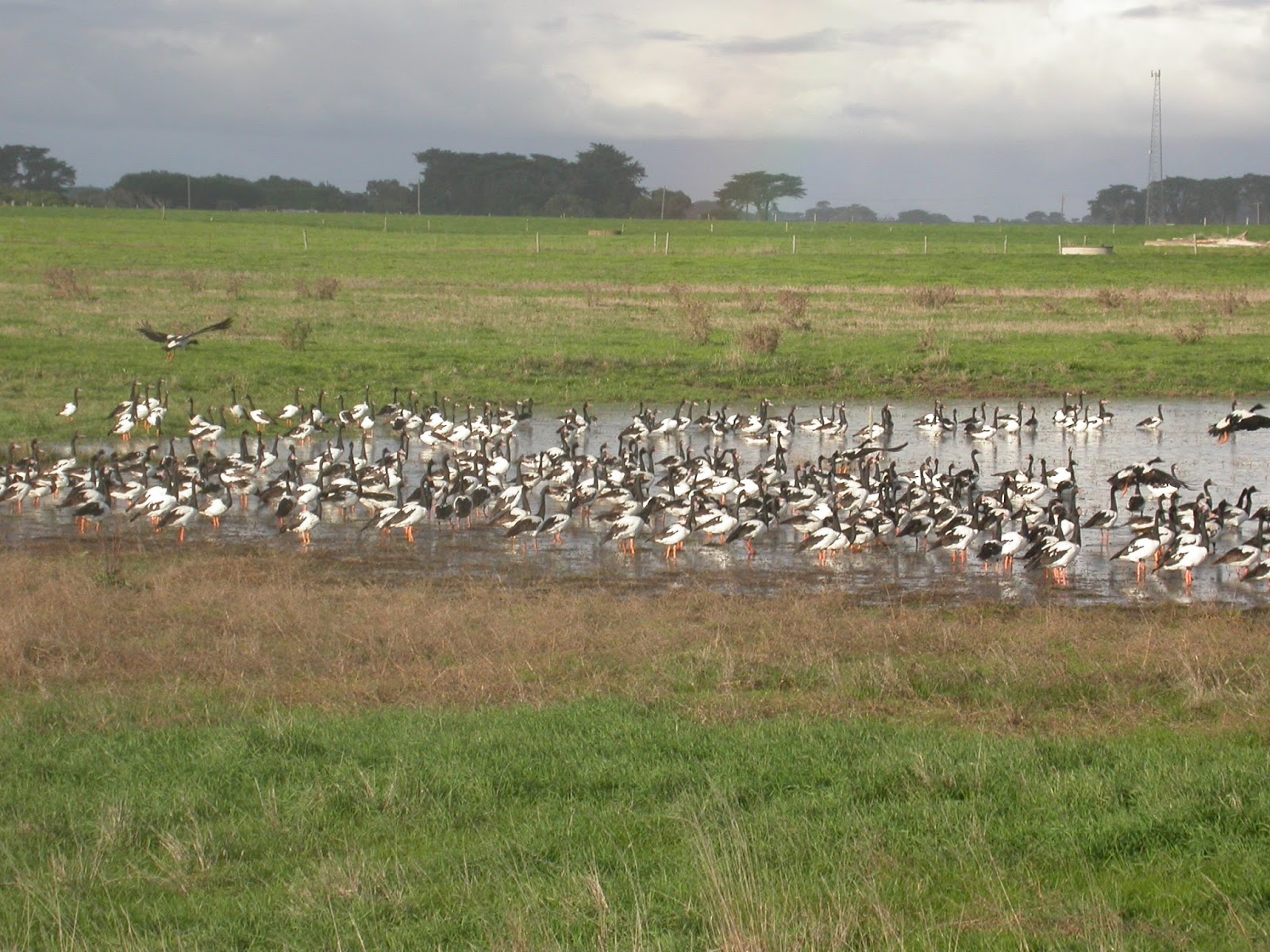
Having seen the threatened wetlands, we decided to check out Goose Lagoon.  We found the place, but couldn't see how to access it.  We drove on the Yambuk Lake, and on the way saw a dam covered in Magpie Geese.  (At last I realized why Goose Lagoon was so called.)

Magpie Geese on dam near Yambuk

Friday was again cold, grey and windy.  We drove to Mt Gambier, stopping at Lower Glenelg National Park.  Along the way we saw a Spotted Harrier and in the park, we saw a Brush Bronzewing and a couple of Australian Spotted Crakes on the river.

On Saturday, we pottered about Port MacDonnell.  I did a pleasant walk in Germein Reserve where the yellow gums were flowering profusely and the New Holland Honeyeaters were making the most of it.  Silvereyes, Red-browed Finches and Grey Fantails were all bathing in the puddles.  I thought it was a bit cold for a bath.

At last, it was Sunday, the day I had waited for for twelve months.  It was still quite dark when we left at 6.15.  Driving from Mt Gambier to Port MacDonnell, we saw an Eastern Barn Owl.  I hoped it might be a good omen.  The boat left right on the dot of 7.  Remarkable is a large fishing boat, with just 12 passengers, so we had good views all day.  And we saw some good birds, too; we just didn't see any Slender-billed Prions.  Most people on board saw an orca and a blue shark and everyone had great sightings of a very cooperative Grey Petrel.
Grey Petrel, photo by Geoff Glare
The petrel flew around the boat and landed near the burleigh, just to make sure everyone had a good look.
Grey Petrel, photo by Anne Looney

We saw six species of albatross, including two wanderers, both giant-petrels and quite a few Grey-backed Storm-Petrels.  Some people saw a Little Shearwater, but for me it was just a tiny dot on the horizon.  We saw a few Fairy Prions, and I tried my best to turn them into Slender-billed.  There were Cape Petrels and one White-fronted Tern.  I managed twenty species for the trip (not counting the Little Shearwater).  Can you believe, they actually provided a barbeque for lunch?

Monday was again raining.  I told myself not to complain, it was, after all, winter.  However the sun did manage to put in an appearance.  In Nelson, we saw a Great Crested Grebe and at Lower Glenelg National Park I saw a Baillon's Crake in the river.  Then in Portland, at Fawthrop Lagoon, I saw a Little Egret, another new bird for the trip.

On Tuesday morning, before we drove home, I made one last attempt at getting Hooded Plovers on my list.  I was not successful, but I did see a Sooty Oystercatcher, bringing my trip total to 115 species, which, given the unfavourable conditions, I thought was okay.  It looks like I will have to try for my Slender-billed Prions again in 2014.  What a shame!  An excuse for another trip to Port MacDonnell.

Friday, 7 June 2013

ROYAL PARK, PARKVILLE

My nephew and I both have birthdays in early June, so we decided that a joint celebratory lunch was in order.  We chose a restaurant in Carlton, which meant I could spend an hour or so in nearby Royal Park beforehand, looking for Swift Parrots.  These endangered parrots have been reported here just once this year, a fortnight ago.

These birds are in trouble.  It is estimated that the total population is 1,000 pairs.  They breed in Tasmania in summer and spend the winter on the mainland.  So far this winter, there have been just three reports in Victoria:  on 21 May, two birds were seen in Royal Park; on the same day three birds were seen at Crusoe Reservoir in Bendigo; and on 30 May, four birds were seen in the You Yangs.  As I set off, scanning all the flowering eucalypts in Royal Park, I knew that my chances of seeing Swift Parrots were not good.

I'd seen Swift Parrots in Royal Park in June 2011, in a eucalypt near the tram tracks.  Perhaps irrationally, I headed for that tree.  There were lots of raucous Rainbow Lorikeets making their presence felt, living up to my Third Law of Birdwatching:  'The more gorgeous a bird's plumage, the less melodious the song; and conversely, the more drab the plumage, the more mellifluous the song.'  It was grey and cold, with no sunshine.  I managed to avoid the golfers, but sadly, I also managed to avoid the Swift Parrots, if indeed there were any there.

Rainbow Lorikeets live up to Sue Taylor's third law of birdwatching.  Photo:  Jim Smart.

I wandered through the park to Trin Warren Tam-boore, totting up a total of 25 species, not altogether bad for a grey winter day in a city park.  I saw plenty of Roger's favourite honeyeater, the New Holland, several overactive Eastern Spinebills and one spectacular Spotted Pardalote, conveniently at eye-level.  There was too much water in the wetlands and I saw no ducks.

I put the absence of Swift Parrots behind me, and turned my mind to celebrating the fact that both my nephew and I had survived another year on this planet.  Happy Birthday, Nephew!

Thursday, 6 June 2013

REGENT HONEYEATERS AND MORE

Just back from a couple of great days birding.  We stayed in Wodonga, and spent most of our time in Chiltern.  We left on Tuesday morning.  I had Brown Thornbills playing outside my bedroom window before we left, despite the grey winter weather.  I thought that was a good omen.  We drove to Nagambie to buy walnuts (the best!) then had lunch at our favourite spot: Fowles winery.  Then it was on to Winton Wetlands, which is one of my top 100 birdwatching sites.  We admired half a dozen male Flame Robins sitting on fence posts looking absolutely splendid, then quite a large flock of Zebra Finches and, finally, some beautiful Diamond Firetails.  They flew across the road in front of the car and I asked Rog to go back, so I could confirm their identification.  Most patiently, Rog complied, and we both enjoyed lovely views of the firetails sitting on the fence and on the roadside verge.
Diamond Firetail taken by Jim Smart

On Wednesday, our first stop was Chiltern Park.  This is a roadside stop on the freeway, just north of Chiltern.  It is actually part of the Chiltern-Mt Pilot National Park, and the birding is always good.  Very soon, you don't notice the noise from the highway traffic close by.  Highlights this morning were several male Scarlet Robins and one darling female Speckled Warbler.  I was delighted to note that many of the ironbarks were flowering prolifically.  I could hope to see Regent Honeyeaters.  Next, we went into the Mt Pilot section of the national park and drove up and down McGuiness Road, hoping for Spotted Quail-thrush.  Sadly, not today.  Then we went to Bartley's Block, where Red Wattlebirds and Noisy Friarbirds predominated.  There were also Golden Whistlers, Eastern Spinebills and a Mistletoebird.  I had always thought that Mistletoebirds were migratory, arriving in Victoria when mistletoe fruits, breeding in summer, then returning north in autumn.  I was surprised to see a handsome male in June.  The only field guide I had with me was Simpson & Day, which classified them as 'sedentary?' so I was none the wiser.  Now I am home, I have checked my records, and they show that Mistletoebirds were always absent in winter from my parents' north-central Victoria home.  I don't think the north-central Victorian Mistletoebirds could be described as 'sedentary.'

Then we drove up Fishers Lane looking for Grey-crowned Babblers.  I had seen them recently in Alice Springs (on my Forest Wagtail twitch) and admired their rich rufous breasts.  The eastern race lacks this colourful breast.  I wanted to see this race and try to remember the difference.  But there were no babblers to be seen here today.

Then we drove into the national park again and saw a couple of cars and two people in the bush and three standing beside the road.  Natually I stopped to ask if they'd seen any Regent Honeyeaters.  Of course, they had.  I introduced myself to Dean Ingwersen from BirdLife Australia, in charge of the Regent Honeyeater recovery program.

Regent Honeyeater, photo thanks to Jim Smart

Dean was radio tracking Regent Honeyeaters that had been bred at Taronga Park Zoo and released in the park last April.  He said there were 14 birds hereabouts.  We saw four.  And extremely beautiful they were too.  No illustration ever seems able to do justice to these birds.  (Sorry, Jim!  It is a lovely photo!)  Although the ironbarks were flowering profusely, the honeyeaters were feeding on insects.  They landed on the trunks of the ironbarks (as if they were treecreepers or robins) and gleaned insects from the bark.  They were all wearing colour bands, but, although we were not far away, I could not identify the colours.  I could have spent hours with Dean, but, after we'd had great views, Rog said it was time to move on.

We visited Frog Hollow, Greenhill Dam, then Honeyeater Dam in Cyanide Road.  The honeyeaters were wonderful (at least seven species).  For a splash of yellow (as well as the Yellow-tufted Honeyeaters) there were Eastern Yellow Robins, Golden Whistlers and Crested Shrike-tits.  Brown and White-throated Treecreepers frolicked side by side.

We visited the other sites (No 1 and No 2 dam, the swamp near the Rutherglen tip and Black Swamp) but we saw nothing more of note.  It was, after all, very wintery.  The sky looked as if it were trying to rain, but couldn't quite make it.  We finished the day with 68 species, which is not too bad for winter.

On Thursday, we visited Wonga Wetlands before we turned homewards.  Yes, Wonga Wetlands is also one of my top 100 birdwatching sites.  I was hoping for egrets.  I needed both Little and Intermediate for my 2013 list.  But, although there was more water than on our previous visit, water levels were still quite low and there were not the water fowl numbers that I'd hoped for.  I saw Australasian Shovelers for the first time here.  Not a rare bird, but I hadn't seen them here before.  There are always Yellow Rosellas, and coots and swamphens and moorhens, but there were not as many passerines as usual today.

It was time to go home.  We had a respectable 94 species, which, I think, is not too bad for winter.